
Part I
The brand
Section 1
How to use this document
This page is the single source of truth for The AI Lab™ brand. Where any deck, press release, help article, product screen or partner document disagrees with it, this page wins and the other document is out of date.
It settles four questions:
- Who we are and what we are for, so that anyone describing us can do it accurately.
- Which marks are protected, which symbol each one carries today, and how to write them.
- How the visual system is built, so a TIP surface built by someone else still looks like a TIP surface.
- Which organisations may use which designations, and what happens when a designation lapses.
The protocol and the brand are licensed separately, and confusing the two is the single most common mistake we see. The specification is open. The name is not.
The distinction that matters most
If you want to use a mark in a way this page does not expressly permit, write to [email protected] with a visual mockup and one paragraph of context. We answer within ten business days.
Section 2
Our mission
The AI Lab Intelligence Unobscured, Inc. is a Delaware C-Corporation founded on January 28, 2026 by Dinesh Mendhe. We build and steward the Trust Identity Protocol®.
To keep the public internet free, verifiable and human readable, so that no person, company, platform or government can take away an ordinary reader's ability to know whether what they are reading was made by another human being.
That mission commits us to four things, and we say them out loud because they constrain what we are allowed to build:
Verification stays free to the reader
Checking whether a piece of content is signed, and by whom, costs nothing and never will. A trust layer you have to pay to read is not a trust layer.
The protocol belongs to no one
TIP is published under an open licence and converts to Apache 2.0 on January 1, 2031. Anyone may implement it. Anyone may run a full node. We cannot revoke that.
Identity is portable, not captive
One human, one TIP-ID, resolvable on any node and movable between Verification Providers. Nobody is locked into us or into their first provider.
Governance happens in the open
The protocol is governed by the AI Trust Council®, a public record keeping body with published charter, bylaws and minutes, not by a product roadmap.
The problem we exist to solve
Generative systems made it trivial to fake a person, a photograph, a voice or an entire body of work. Detection does not fix this: a classifier that guesses whether text was machine written will always be one model generation behind, and it accuses innocent people in the meantime. The durable answer is not detection but declaration, signed by a verified human at the moment of publication and checkable by anyone afterwards. That is what TIP® is.
We use Intelligence, Unobscured. as our line because it names the failure mode we are working against. Intelligence, human or machine, is not the problem. Intelligence passing itself off as something it is not, is.
Section 3
What TIP is, and what it gives you
The Trust Identity Protocol® is an open, post-quantum standard for two linked things: proving that a real, verified human is behind an identity, and proving where a piece of content came from. It has three layers.
TIP-ID
Identity
A verified human bound to a post-quantum keypair through four layer biometric verification. Federated across providers, resolvable on any node, portable for life. One human, one TIP-ID.
TIP-CONTENT
Provenance
A signed record of a piece of content, carrying its Origin Code, a canonical hash and the author fingerprint. This is the CTID that appears in bylines and citations.
TIP-TRUST
Reputation
A four part score reflecting verification depth, declaration accuracy over time, and adjudicated disputes. Published openly so it can be argued with.
What adopting it gives you
These are the benefits we will state publicly. They are the claims marketing copy, decks and partner material may make. Anything stronger needs sign off.
| Who you are | What TIP gives you |
|---|---|
| Creators and journalists | A permanent, portable proof of authorship that survives a platform shutting down, a byline being stripped, or your work being scraped into a training set. Your signature travels with the work, and readers can check it without an account. |
| Publishers and newsrooms | Every article carries a machine readable Origin Code and a verified byline, so syndication partners, aggregators and search engines can distinguish your reporting from a synthetic copy of it. Signing is one plugin, not an engineering programme. |
| Platforms and AI providers | A ready made mechanism for the disclosure obligations regulators are already writing, including EU AI Act Article 50. Origin Codes are the user facing layer, and the cryptography underneath is already post-quantum. |
| Enterprises | Provenance on internal and outbound content, and a defensible audit trail of what was human authored and what was machine generated. This matters in regulated review, in litigation, and in procurement. |
| Regulators and standards bodies | An open specification you can read, test and cite, operated by a body that publishes its governance. No trade secret sits between a regulator and the mechanism. |
| The reading public | The ability to answer one question, free and without signing up: was a human behind this. |
Why it is built the way it is
- Post-quantum from day one. Signatures use ML-DSA rather than a curve that a future quantum computer retires. A provenance record has to outlive the cryptography that was fashionable when it was written.
- Biometrics never leave the device. Verification uses the platform authenticator, Face ID, Windows Hello or an Android TEE, and a PRF derived key protects the post-quantum key at rest. The network stores no biometric template.
- Federated, not centralised. Anyone can run a full node. The ledger is a DAG (TIP Network) replicated across independent operators, so no single company, including us, can switch it off.
- Free where it counts. Verification is free to everyone, always. The licence is free for individuals, nonprofits, journalism, education, government, and businesses under $100K in annual revenue, and converts to Apache 2.0 in 2031.
- Declaration, not detection. The four Origin Codes are declared by the author and bound cryptographically, so accuracy is enforced by reputation and dispute rather than by a classifier guessing.
Claims we do not make
Section 4
Positioning and boilerplate
Approved descriptions at three lengths. Use them verbatim in press releases, partner pages, conference programmes and speaker bios. If you need a variant, ask rather than improvise.
One line
Short, about 50 words
Full, about 100 words
Accuracy rules for the boilerplate
Facts you may state
| Fact | Correct form |
|---|---|
| Legal name | The AI Lab Intelligence Unobscured, Inc. |
| Short name | The AI Lab™, on second reference and in running text |
| Entity | Delaware C-Corporation, incorporated January 28, 2026 |
| Founder | Dinesh Mendhe, Founder and Chairman |
| Tagline | Intelligence, Unobscured. |
| Governing body | AI Trust Council® |
| Primary domain | theailab.org |
Section 5
Voice, tone and writing rules
We write like a standards body that expects to be read by a regulator, a journalist and a developer on the same afternoon. Plain, specific, and willing to state a limitation.
Do
- Write short declarative sentences. State the mechanism, then the consequence.
- Use concrete numbers and name the source. "Free under $100K in annual revenue" beats "affordable for small teams".
- Say what a thing does not do. Naming a limit is how a standards document earns trust.
- Use sentence case for headings and buttons.
- Spell an acronym out on first use: Trust Identity Protocol (TIP).
Do not
- Marketing intensifiers: revolutionary, game changing, unprecedented, seamless, cutting edge.
- Fear as a sales device. The problem is serious enough stated plainly.
- Claiming a partnership, endorsement or certification that does not exist on paper.
- Describing TIP as detecting AI, or a signature as proving something is true.
- Title Case Applied To Every Heading.
Punctuation, a hard rule
Two characters are banned across everything we publish: prose, interface copy, alt text, aria labels, code comments, JSON content, commit messages and social posts.
| Banned | Character | Use instead |
|---|---|---|
| Em dash | — | A comma for a joined clause, a colon for a lead in, or a full stop when both halves stand alone. |
| Middle dot | · | A comma in running text, or a vertical bar in a meta row, breadcrumb or document title. |
The substitution palette is: comma for joined clauses, colon for definitions and list lead ins, vertical bar for meta rows and breadcrumbs, parentheses for a genuine aside, and a full stop when the two halves can stand alone.
Subjects that need care
- Verification Provider economics. The VP economic model is still being designed and is not part of the public launch. Do not describe, imply or estimate a revenue share, commission or per issuance cut. The complete public description of the VP relationship is the annual fee, the independent audit, the quarterly warrant canary, and the jurisdiction declaration.
- Licence tiers. The canonical schedule is nine commercial tiers with a free tier under $100K in annual revenue, published at theailab.org/tip-license. Read that page before writing a threshold or a price. Any earlier five tier schedule, and any $500K free tier ceiling, is retired and must not be republished.
- Trademark symbols. Only two marks carry the registration symbol today. Section 6 is the authority and it changes as certificates issue.
- Scores and disputes. Never present a trust score as a judgement of a person. It is a measure of verification depth and declaration accuracy, and it is appealable.
Part II
The marks
Section 6
Protected marks and symbol use
The following names and marks are owned by The AI Lab Intelligence Unobscured, Inc. and protected under the U.S. Lanham Act, EU Trade Mark Regulation 2017/1001, the U.K. Trade Marks Act 1994, and analogous laws elsewhere.
| Mark | Symbol today | Status |
|---|---|---|
| TIP | ® | Registered on the Principal Register, U.S. Reg. No. 8380201. |
| Trust Identity Protocol | ® | Registered on the Supplemental Register, U.S. Reg. No. 8,329,395. |
| AI Trust Council | ® | Registered on the Principal Register, U.S. Reg. No. 8483190. |
| AI Trust Registry | ™ | Application pending. |
| AI Trust ID | ™ | Application pending. |
| The Global Seal of Trust | ™ | Application approved, certificate pending. Word and design marks filed separately. |
| The AI Lab | ™ | Application approved, certificate pending. |
| Intelligence, Unobscured. | ™ | Application pending. |
| Sentinel, Guardian, Sovereign | ™ | Common law marks used for the three Global Seal of Trust tiers. |
Why the symbol column is not cosmetic
Where to put the symbol
- On the first or most prominent appearance of a mark in a document, page or screen. Repeating it in every sentence is not required and reads badly.
- Set as a superscript at the end of the mark, with no space: TIP®, AI Trust Council®.
- Not inside a URL, a code identifier, an email address, or a monospaced code sample.
- Not in a page title tag or meta description, where it renders as noise in search results.
Other protected brand elements
- The TIP® wordmark and the TIP iD icon.
- The four Origin Code letter pairs, OH, AA, AG and MX, as used in connection with TIP®.
- The visual identity in this document as applied to TIP branded surfaces, including the seven stop brand spectrum.
- The Global Seal of Trust™ and the AI Trust ID™ Seal in every colourway, size and tier.
- Domain names containing TIP or TheAILab. See section 25.
Section 7
Writing the TIP name
Do
- Write TIP in full uppercase as the short form.
- Write Trust Identity Protocol in full, with each principal word capitalised.
- Write TIP-ID hyphenated and uppercase for the identity record.
- Write CTID uppercase for the content identifier.
- Write TIP iD, lowercase i and uppercase D, only when referring to a person's individual identity token.
Do not
- Use TIP as a verb. There is no "we TIPped it".
- Pluralise or make it possessive. Write "multiple TIP registrations", not "TIPs" or "TIP's".
- Expand the acronym to anything but Trust Identity Protocol.
- Write T-I-P or T.I.P.
- Apply the name to anything that is not an implementation of the protocol.
Section 8
Naming your integration
Implementing TIP® from the open specification is fully permitted. Naming your implementation after it is not. Choose your own product name, then describe the integration using one of these forms.
Permitted
Built on TIP Protocol
Permitted
TIP-compatible
Permitted
Implements the Trust Identity Protocol
Permitted
Supports the Trust Identity Protocol
Not permitted
TIP Plugin, TIP Suite, WordPress TIP
Not permitted
Official TIP anything
Worked example
Part III
The visual system
Section 9
Logo, wordmark and assets
Use the files below as provided. Do not redraw, recolour, rotate, stretch, animate, outline, add a drop shadow to, or composite the logo with another mark without written permission.
| Asset | Use | File |
|---|---|---|
| Primary logo | White and light grounds. | /logos/TheAiLab-Logo.svg |
| Gold logo | Navy and dark grounds. | /logos/TheAiLab-Logo-gold.svg |
| High resolution PNG | Print and third party decks. Transparent. | /logos/the-ai-lab-high-resolution-logo_transparent.png |
| TIP mark, light | The icon alone, for dark grounds. | /badge/mark-120-light.svg |
| TIP mark, dark | The icon alone, for light grounds. | /badge/mark-120-dark.svg |
| AI Trust ID Seal | Generated by the Registry, never self drawn. | /badge/seal-120-light-highly-trusted.svg |



Clear space and minimum size
- Clear space on all four sides equals the cap height of the "T" in the wordmark. Nothing enters that margin, including a partner logo.
- Minimum size is 24px in digital contexts and 0.5in in print. Below that, use the icon alone rather than an illegible lockup.
- On a photograph, place the logo on a plain area or a solid panel. Do not rely on a scrim.
The TIP iD icon in a line of text
- Sits on the same baseline as the surrounding text, at roughly cap height.
- Keeps buffer space of at least half the icon width on every side.
- May be hyperlinked together with the
tip://URI beside it, as one target.
Member, Partner and Verification Provider badges
These are issued by The AI Lab to the holder, not generated by the holder. A badge must be removed within thirty calendar days of the underlying status ending. See sections 20 and 21.
Section 10
Colour
The palette is deliberately small. A surface should be able to name every colour on it, and one accent per component is the rule.
Core
Three colours carry the brand. Everything else supports them.
Navy
#0C1A3A
Primary ink on light grounds, primary fill on dark ones.
White
#FFFFFF
The default ground. Pages are white, not cream and not grey.
Gold
#B8942E
Brand accent for chrome: rules, fills, seal artwork, diagram strokes. Never body text.
Surfaces and rules
Surfaces are neutral, never tinted. In a document they carry a specimen or a table header; in an application they fill a card.
Surface
#F6F7F9
Specimen blocks, table headers, inline code.
Surface raised
#EDEFF3
A second level: hovered rows, nested fills.
Rule
rgba(12,26,58,0.13)
Every border and divider on a document surface. Always 1px.
Ink
Three levels of text, and no more.
Primary
#0C1A3A
Headings, table cells, anything the reader must not miss.
Secondary
#505A71
Body copy and list items. 8.3:1 on white.
Muted
#818899
The decorative muted tone. 3.04:1 on white, so it is a hairline value, not a text value.
Label
#636C81
Muted text: eyebrows, captions, table headers, metadata. Same hue, darkened to clear 4.5:1 on white and on the surface.
Accent text
Gold measures 2.50:1 on white, so it cannot carry text. These two do.
Violet on light
#7B2FB5
Links and small accent text on white. 7.20:1.
Violet on dark
#C9A0F0
The same role on navy. 7.98:1. Not interchangeable with the above.
Semantic
Meaning only. Never decoration, and never a substitute for the brand accent.
Green
#1A8A5C
Success, verified, Highly Trusted, and the OH origin code.
Blue
#2563A8
Information, and the Trusted score tier.
Orange
#C07318
Caution.
Red
#C53030
Not Trusted, failure, revocation.
Seal
The Global Seal of Trust artwork has its own two values and does not follow the interface palette.
Seal gold
#C9A84C
Seal lettering and frame.
Seal navy
#0B1629
Seal ground.
Three colour rules that are not negotiable
- Every filled brand surface carries white ink. Gold fill or navy fill, the answer is white. Never gold text on navy, never navy text on gold. This applies to buttons, CTAs, pills, chips, active nav states and confirm buttons.
- Gold is chrome, not text. It belongs on rules, fills, borders, seal artwork and diagram strokes. Gold at 2.50:1 on white cannot carry a sentence. Accent text uses the violet, or the gradient in section 12.
- Never darken the gold to win a contrast argument. The gold is a fixed brand value. If a contrast number looks awkward, change the ink or the surface, not the brand colour.
One accent per component
Section 11
Typography
Three families, all under permissive open licences, so any integrator can adopt the system without a foundry conversation.
| Family | Role | Weights |
|---|---|---|
| Libre Franklin | Display and long form body. Headings, hero type, paragraphs, lists. This is the voice of the brand. | 300 for display, 400 for body, 500 for card and section titles |
| DM Sans | Uppercase labels, eyebrows, kickers, meta rows, buttons. Never long form body. | 400 to 600 |
| JetBrains Mono | Code, CTIDs, TIP-IDs, hashes, any monospaced technical string. | 400 to 700 |
Display, Libre Franklin 300
Section title, Libre Franklin 500
Body, Libre Franklin 400 at 16px and 1.65 line height, measured to 74 characters. Long form prose is set this way everywhere on the brand, because the display weight is too light to read in quantity and anything heavier contradicts the display voice.
Label, DM Sans 500, tracking 0.14em
tip://c/OH-3400957c8e2e5d-4a85
The scale
| Role | Family and weight | Size |
|---|---|---|
| Page headline | Libre Franklin 300 | clamp(26px, 4.8vw, 58px) / 1.08 |
| Section heading | Libre Franklin 300 | clamp(20px, 3vw, 38px) / 1.18 |
| Sub heading | Libre Franklin 500 | clamp(13px, 1.6vw, 18px) / 1.35 |
| Lede | Libre Franklin 300 | clamp(17px, 2vw, 22px) / 1.5 |
| Body | Libre Franklin 400 | 16px / 1.65, measure 74ch |
| List item | Libre Franklin 400 | 15.5px / 1.68 |
| Eyebrow and label | DM Sans 500 | 0.7rem, tracking 0.14em, uppercase |
| Table header | DM Sans 500 | 0.645rem, tracking 0.12em, uppercase |
| Identifier | JetBrains Mono | 0.8rem, tabular numerals |
Rules
- Never ship a heading at weight 600 or 700. The voice is light editorial. A heading that needs more presence gets more size or more tracking, never more weight.
- Display tracking is
-0.015em, so the thin letterforms read as deliberate rather than faint. Body tracking is normal. - Any heading that can wrap uses a line height of at least 1.2. Line height 1.0 is for a single decorative glyph, never for prose.
- Uppercase eyebrows run 11px to 17px at weight 500, tracking 0.14em, in the label ink, preceded by the 1px spectrum tick. An eyebrow labels a field or a kicker. A section heading names a region and stays in sentence case.
- Do not introduce a serif. Cormorant Garamond and Inter are both retired from this system.
- Confirm weight 300 is actually present in the loaded font file. If it is missing the browser synthesises it and the page looks subtly wrong in a way that is hard to diagnose.
Section 12
The spectrum and the accent gradient
Two gradients carry brand signal. They are not interchangeable, and neither is decoration.
The seven stop spectrum, for attention
When a surface needs to say "this one" or "look here", the answer is the spectrum, not a gold tint. Never reorder, recolour or subset the stops.
It appears in exactly two forms.
- The spine. 2px, full height, flush left, over a neutral fill, no border. This marks callouts, notices and active rows. Every emphasised block on this page uses it.
- The outline. The spectrum painted into an existing 1px border with
border-box, to mark one card among peers. Never thicken the border to make room, or the card shifts a pixel when it lights up.
What the spectrum replaced
The accent gradient, for text
Accent text uses a four stop warm gradient clipped to the glyphs. The amber stop is the point: it is where the old gold lived, so the gradient removes the yellow while keeping the brand warmth. Dropping the warm half does not replace gold, it deletes it.
Intelligence, Unobscured.
linear-gradient(100deg, #AB46DD 0%, #F31A7C 36%, #F8712B 51%, #EAAB26 77%)
box-decoration-break: cloneis mandatory. Without it one gradient stretches across every line of a wrapped heading, so the last line lands on the amber stop and renders as the gold you just removed.- Put the gradient on the element that directly owns the text. A child inherits the transparent fill but not the background image, and renders invisible.
- Never put it in a data record's colour field. That value is consumed downstream as a plain colour, and the result is invisible text.
- Leave single glyphs, arrows, and anything rendered on both light and dark grounds as a solid colour.
Where a gradient cannot go, the solid fallback is two tokens and they are not interchangeable: #7B2FB5 on light grounds and #C9A0F0 on dark. No single violet clears 4.5:1 on both, because the passing luminance ranges do not overlap.
Section 13
Layout, borders, buttons, numerals
Structure
- A soft neutral canvas carrying white cards with 1px borders and generous padding. That is the target whenever the brief is "make it feel modern".
- Base spacing unit 4px, typographic scale 1.125. Section spacing in multiples of 32px, card padding in multiples of 16px.
- Documents and applications are different idioms. A long form document, this page, the licence, the revenue plan, is set flush: square corners, 1px rules that separate rather than enclose, and no fills behind prose. An application is set in cards: radii 14px to 20px, button radii 8px to 14px, neutral fills on a soft canvas. Do not mix them. Rounded tinted panels wrapped around paragraphs are the single clearest sign a page was assembled rather than designed.
Borders and rules
- Left accent bars are 2px maximum. Never 3px, never 4px. A thicker bar reads as a frame around the block rather than a marker beside it.
- Cards, tables and dividers use 1px.
- Selection is an inset ring, not a thicker border, so nothing reflows when a card is chosen.
- Flat fills only on callouts. No gradient washes behind copy.
Buttons
- Filled navy and filled gold are the two primary treatments. Both carry white ink.
- Secondary actions earn their border on hover, not at rest. A bordered button on every row competes with the content.
- Focus ring is a plain 2px gold outline at 2px offset. No companion ring, no halo.
Step numerals
- Banned: a navy disc with a gold numeral, and a gold disc with a navy numeral.
- Invert to a white border and white numeral only when the circle sits on a navy ground.
- Always write a literal fallback inside
var(). A border declared against an undeclared custom property is invalid at computed value time, the whole shorthand drops, and the border silently vanishes with no console error.
Mobile
- Touch targets are 44 by 44 CSS pixels minimum.
- CTAs stack full width as pills. No horizontally scrolling chip rails for content.
Section 14
Accessibility
Accessibility is a brand rule here, not a compliance afterthought. A trust layer that cannot be read by everyone is not a trust layer.
- Body text clears 4.5:1. Large text, at 24px or 18.7px bold and above, and non text elements such as rules and icons, clear 3:1.
- Colour never carries meaning alone. Every Origin Code, score tier and status pairs its colour with text, so it survives a screen reader and colour vision differences.
- Every image carries alt text that describes the content, not the file. Decorative elements are marked
aria-hidden. - Focus is always visible: a 2px gold outline at 2px offset, never removed.
- Headings nest in order and are real heading elements, not styled paragraphs.
- Motion respects
prefers-reduced-motion.
Two exceptions we state rather than hide
Section 15
Origin Code badges
The four Origin Codes are the user facing layer of every disclosure obligation TIP® satisfies, including EU AI Act Article 50. Each is a pill or shield carrying the two letters and the standard colour for that code.
Made entirely by a person, with no generative AI. Non generative tools such as spell check, colour grading and noise reduction are permitted.
#1A8A5C badge, #1A875A chip
Made by a person who used AI tools to enhance or partially generate portions. The primary creative work is human.
#B8942E badge, #8F7324 chip
AI performed the primary generation. The person prompted, curated or lightly edited.
#C44569 badge
Human made and AI generated elements combined, with no single dominant origin. The AI portions must be disclosed.
#6B46C1 badge
Display rules
- Always the two letter code in capitals. Never "Oh", never "Original-Human" with a hyphen.
- Always the standard colour for that code. Do not invent a new colour, and do not reassign one code's colour to another.
- The chip is a solid fill with white ink, matching the badge artwork. Not a tinted pill with coloured text.
- Two values per code, and they are not interchangeable. The badge fill is the canonical value, used where the text is large. A small chip carrying white ink uses the darkened value, because two of the canonical fills do not clear 4.5:1 at chip text size. See the table below.
- Code and full name appear together on first reference in a document. Later references may use the code alone.
- Origin Code badges may sit alongside the AI Trust ID™ Seal, the TIP iD icon, a trust score or a timestamp. They never replace the Seal.
- Colour must always be paired with text. See section 14.
| Code | Badge fill | Chip fill, white ink | Ratio |
|---|---|---|---|
| OH | #1A8A5C | #1A875A | 4.51:1 |
| AA | #B8942E | #8F7324 | 4.52:1 |
| AG | #C44569 | #C44569 (unchanged) | 4.77:1 |
| MX | #6B46C1 | #6B46C1 (unchanged) | 6.42:1 |
OH is darkened by one percent, which is imperceptible. AA is darkened materially, because gold under white ink measures 2.87:1 at the canonical value and is the weakest pairing in the product. AG and MX clear the floor unchanged. Keep the measured ratio in a comment beside any rule that reproduces these.
A drift that keeps recurring
Section 16
TIP-ID and CTID display
The TIP-ID is the persistent identifier for a verified human or organisation. The CTID is the persistent identifier for a registered piece of content. Both are designed to be printed in bylines, citations and reference lists.
Formats
| Identifier | Form | Reading |
|---|---|---|
| TIP-ID | tip://id/US-js4a8b2c1d9e7f30 | Two letter country code for the jurisdiction of the issuing Verification Provider, then a 16 character fingerprint. |
| CTID | tip://c/OH-3400957c8e2e5d-4a85 | Two letter Origin Code, then a 14 character hash fragment of the canonical content, then a 4 character author fingerprint. |
In a byline
In a citation
Mendhe, D. (2026). Trust Identity Protocol Specification, Version 2.0. The AI Lab Intelligence Unobscured, Inc. OH tip://c/OH-3400957c8e2e5d-4a85
Where the badge cannot render
When a CTID is pasted into a social post, an email or a forum that will not render the inline badge, the system appends a two line fallback. This is the canonical form.
Click to find out #HumanOrAI
Identifier fields in an interface
- A copyable identifier field is neutral everywhere it appears: neutral surface, 1px border, monospaced text at full ink contrast. Never a tinted fill.
- The copy button is a soft neutral pill that turns green on success.
- Hyperlink the URI to the public resolver. The
tip://form may be wrapped ashttps://tip.theailab.org/r/{ctid}for browser compatibility, or the equivalent resolver of the integrating Verification Provider.
Section 17
The Global Seal of Trust
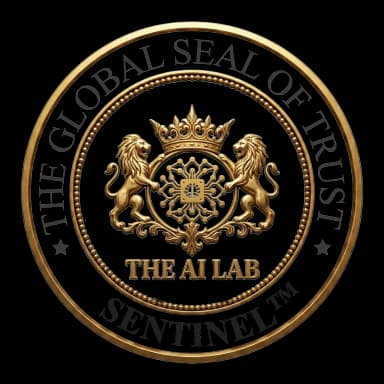
The Global Seal of Trust™ is the public certification mark. It has three tiers, each with its own artwork, and a star variant marking founding status.
Sentinel
/seals/sentinel_the_ai_lab_1.webp
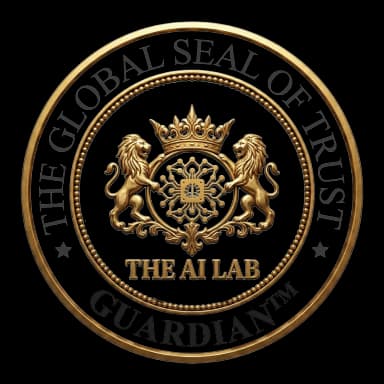
Guardian
/seals/guardian_the_ai_lab_1.webp
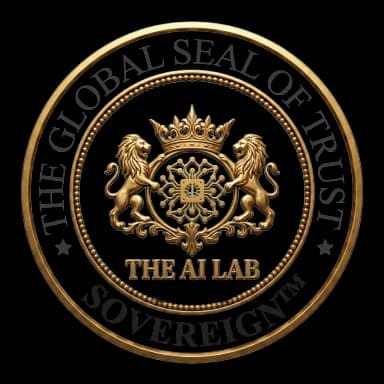
Sovereign
/seals/sovereign_the_ai_lab_1.webp
- Seal artwork uses its own two values, seal gold
#C9A84Cand seal navy#0B1629, and does not follow the interface palette. - The Seal is issued through the Registry. A holder displays the file they were given and never regenerates, recolours or re-tiers it.
- Sentinel, Guardian and Sovereign are the three Seal tiers. They are not licence tiers. The licence schedule is nine commercial tiers published at theailab.org/tip-license, and any earlier five tier naming is retired.
- Seal lettering stays gold. This is one of the places gold is correct as type, because it is artwork rather than interface text.
Part IV
Who may use what
Section 18
General guidance
Anyone looking at a third party site, app or publication should be able to tell, at a glance, that the third party is not The AI Lab and is not the source of the protocol. Three principles sit behind every specific rule below.
Clarity of source
A reader, regulator or buyer encountering TIP® anywhere should be able to tell immediately whether they are looking at The AI Lab itself, an accredited Verification Provider, a Member organisation, or an independent implementer working from the open licence.
No suggestion of endorsement
Permitted brand use does not imply endorsement, sponsorship, partnership or any commercial relationship. "Endorsed by TIP", "official TIP partner", "approved by The AI Lab" and "in partnership with TIP" all require a written agreement that exists before the phrase is published.
No appropriation of the marks
Implementing TIP® from the open specification is fully permitted. Calling your implementation TIP, or any visually or aurally similar variation, is not. See section 8.
Section 19
Apps, products and look and feel
What you may display in your product
- The TIP iD icon, the Origin Code badges, and the AI Trust ID™ Seal, shown alongside the verification flow they describe.
- A statement that your product implements the protocol, in one of the forms in section 8.
- The colour palette and typography in sections 10 and 11, to harmonise your TIP related surfaces with the rest of the ecosystem.
What you may not
- Use the TIP® wordmark, or the AI Trust Council®, AI Trust Registry™ or Global Seal of Trust™ marks, as your product name, product logo or visual identity.
- Copy the visual design of theailab.org, vp.theailab.org or any subdomain we operate. Harmonising a badge is not the same as reproducing a page.
- Generate your own Seal artwork. Seals come from the Registry.
Section 20
Verification Provider branding
Verification Providers are organisations accredited by The AI Lab to issue TIP-IDs under TIP Terms of Service Section 6. Accreditation carries specific brand permissions in exchange for specific operational obligations: an annual independent security audit, a quarterly warrant canary, a published jurisdiction declaration, the VP Code of Conduct, and the annual accreditation fee.
Do
- Display the "Accredited Verification Provider" badge issued to you, with your jurisdiction tier indicator.
- Use the phrase "Accredited TIP Verification Provider" in marketing, alongside your own brand.
- Display the TIP iD icon and Origin Code badges inside your identity issuance product.
- Display the AI Trust ID™ Seal generated through the Registry on the TIP-IDs you issue.
Do not
- Use the TIP® wordmark as part of your product or company name.
- Claim to be an "Official TIP Provider". There is no such designation. All accredited VPs are equal.
- Claim endorsement by The AI Lab without a separate written endorsement.
- Display a Seal you generated rather than received from the Registry.
Loss of status
A VP that loses accreditation must remove all TIP brand display from its website, marketing materials, product and signage within thirty calendar days. Continued display after loss of status is a trademark violation enforceable under the Lanham Act and analogous laws elsewhere.
Section 21
Member and Partner designations
| Designation | What it is | How it is granted |
|---|---|---|
| TIP Member | An organisation that has joined the public membership of the AI Trust Council®. Members receive a badge, voting rights within their constituency, and a listing on the public roster. | By the Council, under the procedures in the Governance Framework. |
| TIP Partner | An organisation that has signed a Partnership Agreement with The AI Lab for joint commercial, technical or research activity. Partner designations may carry custom permissions scoped to the partnership. | Bilaterally, by written agreement. |
Badge display
- On your website at a single location, typically the footer, the About page or a dedicated partners page.
- On marketing collateral in the footer or credits area.
- At events, alongside your own signage.
The badge must not be displayed in a way that suggests the holder speaks for TIP®, operates TIP®, or publishes these guidelines. It must be removed within thirty calendar days of the status ending.
Section 22
Standards bodies and regulators
TIP® is designed to be a technical standard input and a compliance mechanism. Co-branding in these contexts is encouraged and follows different rules from commercial co-branding.
Standards bodies
When TIP® is submitted as a standard contribution to NIST, ISO, IETF, W3C, ENISA, ETSI, BSI or an analogous body, that body's published documents may reference TIP by name and display the wordmark in editorial diagrams and tables. No permission request is needed. We ask for notification, not approval, so the published reference can be cross linked from theailab.org.
Regulators
When a regulator publishes guidance, an advisory or an implementing act referencing TIP® as a recognised compliance mechanism, the regulator may display the wordmark in that guidance. On request we provide high resolution assets, an executive summary, a technical briefing and a named point of contact.
Section 23
EU AI Act Article 50 co-display
EU AI Act Article 50 transparency obligations became enforceable on August 2, 2026. TIP® provides open, post-quantum infrastructure that makes Article 50 disclosure routine. See theailab.org/eu-ai-act for the compliance guide. The rules below govern brand co-display in that context.
The Article 50 badge
A platform, publisher or generative AI provider that has implemented Origin Codes on its content surface and subscribed to the published Article 50 Code of Practice may display the badge "EU AI Act Article 50 compliant via TIP" alongside the AI Trust ID™ Seal on its compliance disclosures, terms of service and corporate site. The badge is issued on request after a brief self attestation. There is no charge for the self attestation.
Co-display with the CE marking
The TIP® brand may appear in the same regulatory disclosure block as the CE marking, the EU Trust Mark and other EU recognised compliance indicators. It must not be displayed in a way suggesting TIP is itself a CE marking, a notified body designation, or a regulatory authority. TIP is a private sector technical compliance mechanism and the block must make that distinction clear.
Language editions
"Trust Identity Protocol" and "TIP" stay in English in every EU language edition, the way "C2PA" and "GDPR" do. Translators may add a parenthetical translation on first appearance, for example in German "Trust Identity Protocol (Vertrauens-Identitäts-Protokoll, TIP)", but the mark itself is not translated.
European regulator and national authority questions go to [email protected].
Section 24
Community and consortia
Community led sites promoting TIP® adoption within a region, language community, professional sector or interest area are encouraged.
Do
- Use a URL path containing "tip", for example
university.edu/tip. - Use a subdomain containing "tip" where your own name is the parent domain, for example
tip.libraryassociation.org. - Display the TIP® wordmark in your hero, navigation and content, alongside your own branding.
- Link back to theailab.org as the official source.
Do not
- Register a domain using TIP as the entire brand portion, for example
tip.deortip.eu. - Copy the visual design of theailab.org or vp.theailab.org.
- Hold the community out as the official source or as a representative of The AI Lab.
For a non standard domain pattern or visual approach, write to [email protected] with a mockup and one paragraph of context.
Section 25
Domain usage
Domains we operate
| Domain | What it is |
|---|---|
| theailab.org | Corporate site, brand guidelines, policies, documentation. |
| vp.theailab.org | Verification Provider portal. |
| tip.theailab.org | Live protocol surface and public resolver. |
| badge.theailab.org | Badge generation and validation. |
Reserved patterns
A domain in which "tip" or "theailab" or a confusingly similar string is the entire brand portion is reserved to The AI Lab, regardless of top level domain. Existing third party registrations of such domains are addressed under the Uniform Domain-Name Dispute-Resolution Policy and analogous national procedures.
Acceptable patterns
- Path based, the cleanest option:
publisher.com/tip,library.university.edu/tip,newsroom.media.com/tip-protocol. - Subdomain based, where your own name is the parent:
tip.publisher.com,tipprotocol.library.org.
Section 26
Misuse and enforcement
We enforce narrowly. The purpose is to protect readers and honest implementers from being misled, not to police every mention of our name. Nominative reference, criticism, comparison, journalism and academic citation need no permission and never will.
What we act on
- A product or company name that incorporates a protected mark.
- A claim of accreditation, membership, partnership, endorsement or certification that does not exist.
- A self generated Seal, badge or designation, or one retained after the underlying status ended.
- A site that reproduces our visual identity closely enough that a reasonable visitor would believe it is operated by The AI Lab.
- Use of ® on a mark that is not registered, including by third parties writing about us.
- A domain registration in which a protected mark is the entire brand portion.
What we do not act on
- Naming TIP® accurately in an article, review, comparison table or research paper.
- Stating truthfully that a product is built on TIP or is TIP-compatible.
- Criticising the protocol, the Council or the company.
- Forking, modifying or redistributing the reference implementation within the terms of its licence.
How enforcement starts
Section 27
Attribution, permissions and contact
Required attribution statement
Any document, presentation, marketing material or product interface using a TIP related mark includes this statement at least once, in a footer, credits area or legal notices section. It is reproduced exactly, including the symbols.
TIP® and Trust Identity Protocol® are registered trademarks, and AI Trust Council™, AI Trust Registry™, AI Trust ID™, The Global Seal of Trust™, Sentinel™, Guardian™, Sovereign™ and The AI Lab™ are trademarks, of The AI Lab Intelligence Unobscured, Inc.
Who to write to
| Subject | Address |
|---|---|
| Brand, trademark and community questions | [email protected] |
| Verification Provider accreditation and branding | [email protected] |
| EU regulator and policy engagement | [email protected] |
| Commercial licensing above the free tier | [email protected] |
| Press and journalism | [email protected] |
Licence of this document
The text of these guidelines is published worldwide under the Creative Commons CC0 1.0 Universal Public Domain Dedication, so any organisation may copy, adapt and fold these rules into its own documentation. The dedication covers the text only. It transfers no rights in the marks the guidelines protect, which remain owned by The AI Lab Intelligence Unobscured, Inc.
Version
Version 2.0, updated August 29, 2026. The current version is always at theailab.org/brand-guidelines. Material changes are announced in advance through the AI Trust Council® mailing list and the public archive at theailab.org/insights.