
Publication
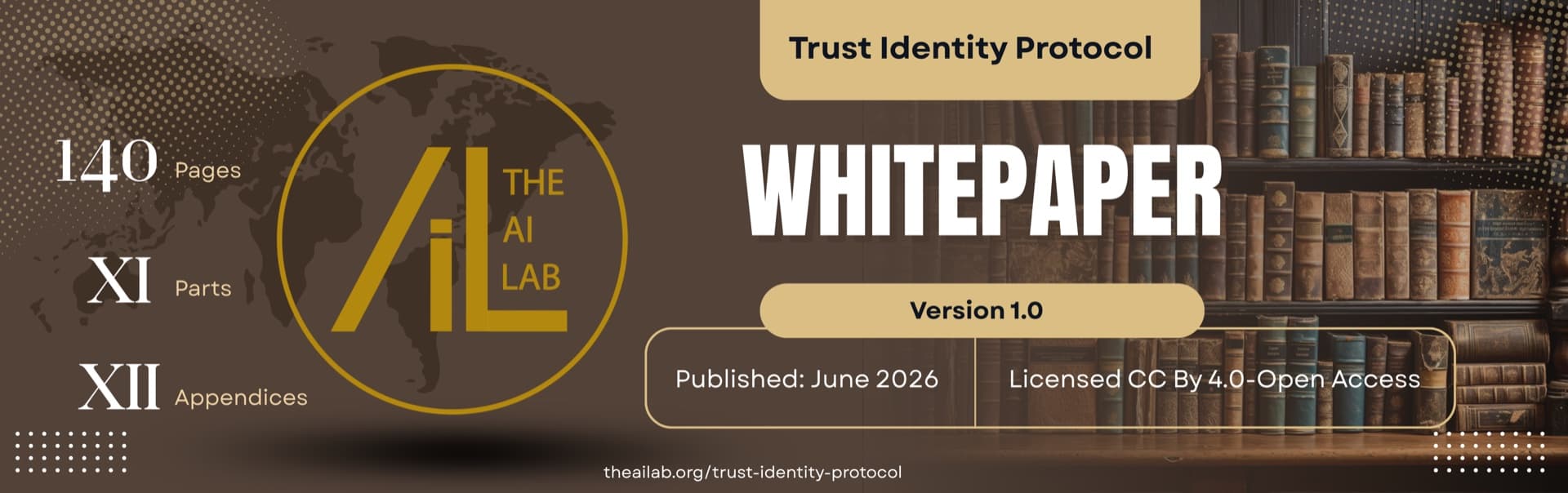
The TIP Protocol Whitepaper Version 1.0 is Published: 140 Pages, Eleven Parts, Twelve Appendices, Licensed CC BY 4.0
Today we publish the TIP Protocol Whitepaper, Version 1.0, by Dinesh Mendhe. One hundred forty pages setting out the post-quantum, federated, multi-stakeholder open standard for verified human identity and content provenance on the internet. PDF, HTML, EPUB, and DOCX are available now at theailab.org/whitepaper.
Today we publish the canonical specification of the open standard that lets any real person prove they are human, and any piece of content declare how it was made.
Read or download
theailab.org/whitepaper | PDF, HTML, EPUB, DOCX
theailab.org/whitepaper/errata | Errata and corrections
Today we publish the Trust Identity Protocol Whitepaper, Version 1.0. One hundred and forty pages. Eleven Parts. Twelve Appendices. Licensed under Creative Commons Attribution 4.0. Available in PDF, HTML, EPUB, and DOCX. This is the canonical public specification of the open standard that lets any real person prove they are human, and any piece of content declare how it was made.
What the whitepaper sets out
The whitepaper documents three layers of the protocol. TIP-ID is the identity layer, in which a real person obtains a verified TIP-ID from an accredited Verification Provider after a four-step biometric verification process. TIP-CONTENT is the content provenance layer, in which any unit of digital content (article, image, audio, video, document) is canonically normalised under CNA-2.2 and bound to a Content TIP ID that records the author, the moment of publication, and the origin code (Original Human, AI-Assisted, AI-Generated, Mixed). TIP-TRUST is the reputation layer, in which the protocol's Trust Score, spanning five tiers from HIGHLY_TRUSTED to NOT_TRUSTED, reflects the operational record of identity holders and content creators over time.
Post-quantum at the start, not as a migration
The protocol's cryptographic primitives are ML-DSA-65 (FIPS 204) for digital signatures, ML-KEM-768 (FIPS 203) for key encapsulation, and SLH-DSA (FIPS 205) for hash-based long-term archival signatures. NIST published these three standards in August 2024. TIP was designed to use them from genesis. There is no future "post-quantum migration" because there is nothing to migrate away from.
The AI Trust Council and Article 95(3)
The protocol is stewarded by the AI Trust Council, an independent multi-stakeholder body convened on May 3, 2026 under a written Charter ratified by the sole director of The AI Lab Intelligence Unobscured, Inc. The Council's composition, decision rights, independence covenants, and Member roster are documented in Part X of the whitepaper. The Council is structured to be the kind of multi-stakeholder body contemplated by Article 95 of the EU AI Act. Article 95(3) specifically provides that voluntary codes of conduct may be drawn up with the involvement of any interested stakeholders and their representative organisations, including civil society organisations and academia. The Council was designed against that requirement.
Built for the regulations that exist, not the ones that might
The whitepaper's Part IX maps the protocol against the regulatory frameworks of multiple jurisdictions. The European Union: the AI Act (Regulation (EU) 2024/1689), the GDPR (Regulation (EU) 2016/679), the Digital Services Act (Regulation (EU) 2022/2065), eIDAS 2.0 (Regulation (EU) 910/2014 as amended by Regulation (EU) 2024/1183), the NIS2 Directive (Directive (EU) 2022/2555), the Cyber Resilience Act (Regulation (EU) 2024/2847), and the Council of Europe Framework Convention on AI (CETS No. 225). The United States: Section 5 of the Federal Trade Commission Act (15 U.S.C. § 45), state biometric statutes including Illinois BIPA (740 ILCS 14), Texas CUBI (Tex. Bus. & Com. Code § 503.001), Washington RCW 19.375, the Colorado AI Act (Senate Bill 24-205), and NYC Local Law 144 (Automated Employment Decision Tools). The United Kingdom: the Online Safety Act 2023 and the Data Protection Act 2018. New Zealand: the Privacy Act 2020 (No. 31 of 2020). India: the Digital Personal Data Protection Act 2023 (No. 22 of 2023). The international layer: OECD Recommendation on AI (OECD/LEGAL/0449) and the Council of Europe Framework Convention.
Free for the people the regulations hit hardest
The protocol specification is published under CC BY 4.0. The reference implementations are licensed under TIPCL-1.0, with a self-executing conversion to Apache 2.0 on January 1, 2031. TIPCL-1.0 grants a no-fee Free Tier to individuals and small businesses under one hundred thousand US dollars of annual revenue, all nonprofits, all educational institutions, all government entities, and journalism organisations for editorial use. Commercial Licenses for parties not eligible for the Free Tier are issued on a uniform nine-tier schedule, with annual fees ranging from five hundred to five hundred and fifty thousand US dollars depending on annual gross revenue. The fee schedule is uniform across all licensees within each tier. It is published in advance. It is not negotiated on a per-licensee basis. This is FRAND licensing in operation.
Federated, not platform-controlled
The protocol runs as a federated directed acyclic graph operated by Founding Node Operators in four jurisdictions. At the date of publication, the network is operated by seven Founding Node Operators with signed Founding Node Operator Agreements, and three additional Founding Node Operators in accession. The protocol is not yet in live production; the network is in pre-Genesis operating mode. Live production operation commences on the Genesis Date, a date in June 2026 to be determined by the sole director of The AI Lab on the satisfaction of the Operational Readiness Conditions described in Part XI of the whitepaper.
The standing this whitepaper rests on
In the thirty days preceding the publication of this whitepaper (between mid-May 2026 and June 16, 2026), theailab.org recorded in excess of four million page visits, and the supporting video explainers recorded in excess of one million views on the YouTube platform. The Council reports this empirical evidence of stakeholder interest as the leading indicator of the standing demand for the protocol the Council stewards. Updated figures are published on a continuing basis at the canonical web property at theailab.org, on the YouTube platform at youtube.com/@theailaborg, and on the LinkedIn platform at linkedin.com/company/the-ai-lab-org and linkedin.com/company/ai-trust-council.
What to do next
If you are a journalist or publisher: the whitepaper is the canonical reference for how the protocol verifies your work. Section 5.2.1 documents the universal seventeen-type content taxonomy that maps every publishing surface (blog post, news article, newsletter issue, essay, review, tutorial, press release, video, audio, document, and more) to the protocol's signing format.
If you are an AI provider or deployer: Part IX maps the protocol against Article 50 (the marking and disclosure obligations that become operational on August 2, 2026) and Article 95 (the codes of conduct framework). The protocol is the open, free, post-quantum infrastructure that satisfies both.
If you are a regulator: the AI Trust Council Charter, the licensing schedule, the independence covenants, the Verification Provider accreditation framework, and the federated network governance are all documented under theailab.org/ai-trust-council. The whitepaper is the substantive policy document.
If you are an institution considering becoming a Founding Node Operator, a Verification Provider, or an AI Trust Council Member: [email protected].
How to cite the whitepaper
Mendhe, D. (2026). Trust Identity Protocol (TIP): An Open Standard for Verified Human Identity and Content Provenance on the Internet (1.0). The AI Lab Intelligence Unobscured, Inc. https://doi.org/10.5281/zenodo.20722378
The whitepaper is permanently archived on Zenodo (operated by CERN) under DOI 10.5281/zenodo.20722378. The Concept DOI 10.5281/zenodo.20722377 always resolves to the latest printing. The Zenodo record is at zenodo.org/records/20722378. The author ORCID iD is 0000-0003-1158-3259.
Read the whitepaper at theailab.org/whitepaper. Subscribe to The AI Lab Insights at /feed.xml (RSS) or /feed.json (JSON Feed). Our mission: make truth verifiable.