
Guest Essay
All Data Is Sovereign: Sovereignty and Responsibility in the Age of AI
AI turns stored data into inference, decisions and action. That makes two questions unavoidable for every person, company, city and nation: whose data is it, and whose law speaks for it.
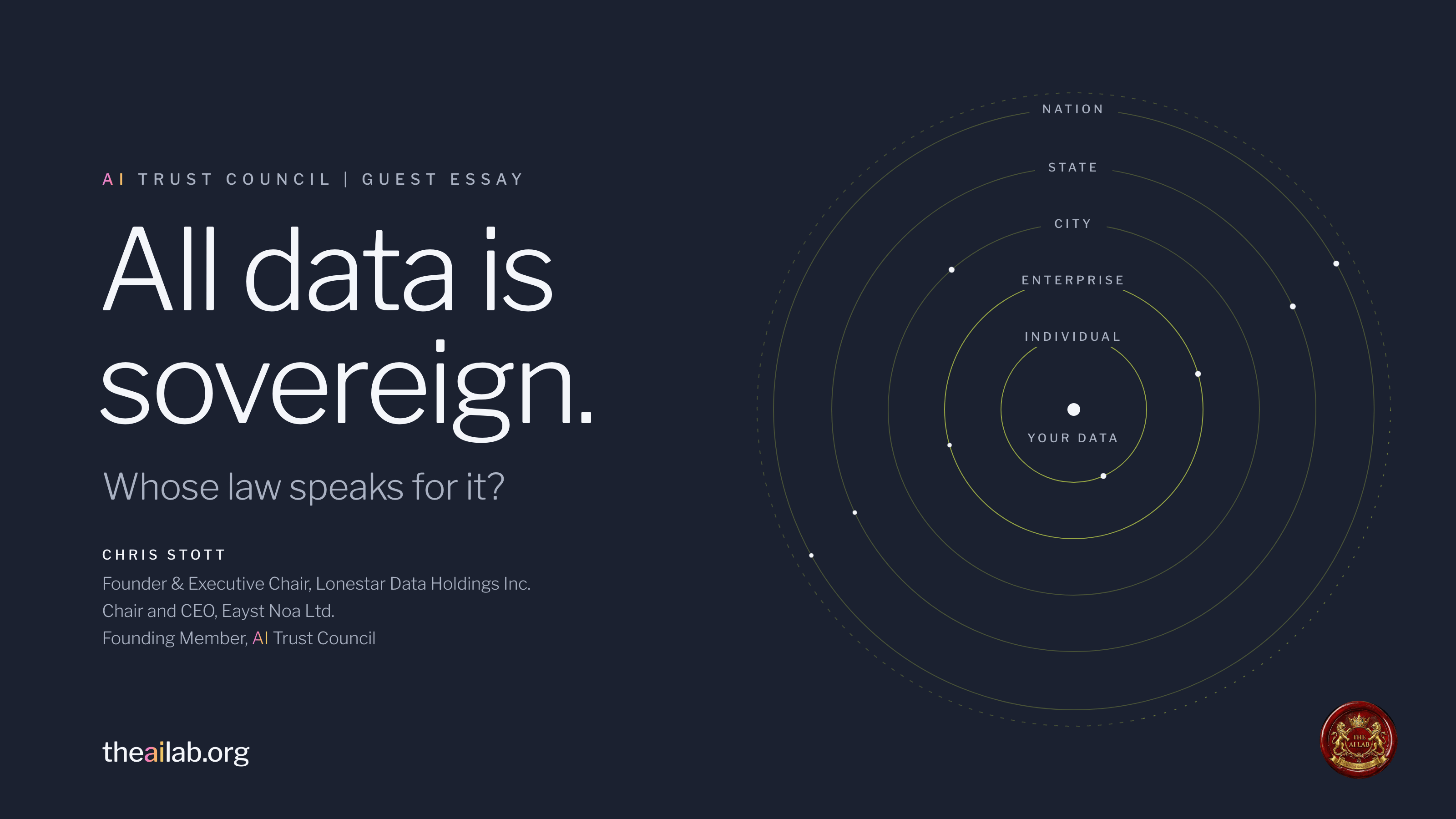
One datum, and every circle of authority that claims it, from the person to the nation.
For much of the digital age, we have treated data primarily as a technical problem.
Where do we store it? How quickly can we move it? How cheaply can we process it? How much can we collect?
The age of AI is forcing us to confront a more fundamental question:
Whose data is it?
And immediately behind that comes another:
Whose law speaks for it?
These questions are becoming central not only to nations, but to states, cities, enterprises, institutions, and ultimately to each of us as individuals.
This is the emerging age of data sovereignty.
Sovereignty begins with the person
Not sovereignty in the narrow sense of where a server happens to sit. Sovereignty in its deeper meaning: ownership, authority, jurisdiction, control and responsibility.
The data you create is yours.
The data created about you is also part of your digital existence.
Your financial history. Your health. Your communications. Your movements. Your photographs. Your work. Your ideas. Your relationships. Your identity. Increasingly, the accumulated data surrounding a human being becomes a digital representation of that person. In the age of AI, it is also the raw material from which machines can understand, predict and act upon their world.
That makes sovereignty personal.
But the principle scales.
A company creates intellectual property, operational records, customer information, financial histories and institutional knowledge. That data represents decades of accumulated enterprise value.
A city generates infrastructure, transportation, public safety, planning and citizen data.
A state holds records fundamental to the lives of millions of people.
A nation possesses data concerning its citizens, economy, security, culture, scientific knowledge and history.
These are not merely collections of bits.
They are assets of sovereignty.
Borders, jurisdiction and the law
And yet much of the digital world was built before we fully appreciated this.
Data crosses borders almost invisibly. It may be stored in one country, processed in another, backed up in a third and managed by a corporation headquartered in a fourth. The physical location of data, the nationality of its owner, the jurisdiction governing the infrastructure and the laws capable of compelling access to it may all be different.
That creates one of the defining questions of our time:
Whose law speaks for your data?
The answer matters.
Because jurisdiction is not an abstraction. Jurisdiction determines which government can regulate data, which court can compel access to it, which privacy protections apply, which national-security authorities may reach it, and ultimately who has the legal power to say yes, or no.
For nations, that is sovereignty.
For enterprises, it is governance.
For individuals, it is autonomy.
AI turns data into intelligence
And AI raises the stakes enormously.
Data is no longer something we simply store and occasionally retrieve. It is becoming something from which intelligence is continuously derived.
AI turns stored information into inference.
Inference into decisions.
Decisions into actions.
And increasingly, actions into autonomous agents capable of operating on our behalf.
That means control of data is becoming inseparable from control of intelligence itself.
The question therefore evolves from “Where is my data?” to:
Who can access it? Who can learn from it? Who can train on it? Who can infer from it? Who can act upon it? And under whose authority?
Sovereignty carries responsibility
This is why sovereignty must be accompanied by another principle:
Responsibility.
Sovereignty cannot simply mean demanding control. It means accepting responsibility for what we control.
If an individual claims sovereignty over personal data, there is a responsibility to understand and protect it.
If an enterprise claims sovereignty over corporate and customer data, it assumes responsibility for preserving it, securing it, governing its use and ensuring its availability.
If a city or state holds the data of its citizens, sovereignty creates an obligation to protect that data across generations, administrations and technological change.
And if a nation asserts digital sovereignty, it also accepts the responsibility to provide the legal, technical and institutional infrastructure necessary to make that sovereignty real.
Sovereignty cannot simply mean demanding control. It means accepting responsibility for what we control.
Sovereignty and responsibility are therefore intrinsically linked.
One cannot credibly exist without the other.
What data will be worth tomorrow
This requires a change in how we think about data itself.
For decades, organizations have divided information into categories: critical and non-critical, hot and cold, useful and obsolete, valuable and disposable.
AI is challenging those distinctions.
An apparently insignificant dataset today may become extraordinarily valuable tomorrow when combined with new models, new analytical techniques or information that does not yet exist.
A forgotten engineering record may solve a future problem.
Historical medical information may reveal a pattern invisible to contemporary science.
Old climate observations may improve future models.
Corporate archives may contain institutional knowledge that cannot be reconstructed once lost.
Family photographs, correspondence and personal histories may have little monetary value today but immeasurable human value to generations not yet born.
We cannot always know today which data tomorrow will consider important.
That leads to a deceptively simple proposition:
All data has value.
And if data has value to the person, institution, enterprise, city, state or nation that creates or holds it, then its governance matters.
All data is sovereign.
This does not mean every byte requires identical protection. Sovereignty is not the absence of classification, sharing or collaboration. Nations trade. Companies partner. People choose to share intimate parts of their lives.
Sovereignty means those decisions should begin with the rightful owner and take place within a clearly understood framework of authority and responsibility.
From storage to stewardship
The future of data therefore cannot be built solely around capacity, compute and connectivity.
It must also be built around custody, jurisdiction, provenance, resilience and trust.
The AI age will make these questions impossible to avoid.
As intelligence becomes increasingly derived from data, the societies and organizations that understand the sovereignty of their data will possess something more important than technological advantage.
They will possess agency.
The ability to decide where their information resides.
The ability to determine whose laws govern it.
The ability to decide who may access it.
The ability to determine what intelligence may be derived from it.
The ability to preserve it independently of any single technology, vendor or political moment.
And the responsibility to protect it for those who come next.
We are moving from an age in which data was treated as a by-product of the digital world to one in which data is recognized as one of its foundational assets.
That changes the conversation.
From storage to stewardship.
From access to authority.
From compliance to responsibility.
From location to jurisdiction.
From data protection to data sovereignty.
For the individual.
For the enterprise.
For the city and the state.
For the nation.
And eventually, perhaps, for every human being.
Your data is part of your sovereignty.
Sovereignty carries responsibility.
All data has value.
All data is sovereign.
Frequently Asked Questions
What is data sovereignty?
Data sovereignty is the idea that data belongs under the authority of whoever creates it or rightfully holds it. In this essay it means more than where a server sits: it is ownership, authority, jurisdiction, control and responsibility, and it applies to the individual, the enterprise, the city, the state and the nation.
Why does AI make data sovereignty more urgent?
Because AI turns stored information into inference, inference into decisions, and decisions into actions, increasingly taken by autonomous agents. Control of data is becoming control of the intelligence derived from it, so the question moves from where data is stored to who can access it, learn from it, train on it, infer from it and act on it, and under whose authority.
Whose law applies to data stored in another country?
It depends, and that is the problem the essay names. Data may be stored in one country, processed in another, backed up in a third and managed by a company headquartered in a fourth. The location of the data, the nationality of its owner, the jurisdiction governing the infrastructure and the laws able to compel access to it can all differ.
Does data sovereignty mean data can never be shared?
No. Sovereignty is not the absence of classification, sharing or collaboration. Nations trade, companies partner and people choose to share parts of their lives. Sovereignty means those decisions begin with the rightful owner and take place within a clear framework of authority and responsibility.
Why should organizations keep data that seems unimportant today?
Because nobody can know today which data tomorrow will value. An apparently insignificant dataset can become valuable when combined with new models, new techniques or information that does not yet exist, and corporate archives can hold institutional knowledge that cannot be rebuilt once it is lost.
Chris Stott is the Founder and Executive Chair of Lonestar Data Holdings Inc., which provides resilient, space-based, sovereignty-compliant data storage, Chair and CEO of Eayst Noa Ltd., and a Founding Member of the AI Trust Council. He is also Founder and Non-Executive Chair of River Advisers (ManSat) and Chair Emeritus of Space and Satellite Professionals International (SSPI). Read his Council profile.
Provenance is one of the five properties this essay asks data to carry. Read how the Trust Identity Protocol records who made a piece of content and whether it has changed since, or start at vp.theailab.org.