
Leadership Essay
Anyone Can Say It. You Can Prove It.
Faking a photo, a voice or a paragraph became free. Proving your own work did not. That asymmetry is the quiet tax on everyone who makes things, and it is fixable.
The burden of proof moved onto the people who make things.
Picture an afternoon that no photographer should have to spend. An editor asks, politely and without malice, for something to show that the filed image is genuinely hers and genuinely real.
So she sends the raw file. Then the frames on either side of it. Then a screenshot of the folder with its dates, and an offer of the camera’s serial number. None of it is proof, exactly. It is a pile of circumstantial material that adds up to a feeling, and the feeling is the best anyone can currently do.
Say the editor believes her. That is not the point. The point is the afternoon, and how many of them are now being spent this way.
The cost of faking went to zero. The cost of proving did not.
For most of the history of making things, forgery was expensive. A convincing fake painting took a skilled painter. A convincing fake document took a skilled hand. A convincing fake voice took an impersonator, a studio and luck. Because fakes were costly, honest work did not have to prove anything. Being real was the cheap default.
That arrangement has quietly ended. Producing a passable fake now costs a few seconds and no talent. Producing proof that something is not a fake still costs an afternoon, a folder of raw files and somebody’s patience.
When one side of an equation falls to nothing and the other stays where it was, the result is not a fair fight. It is a tax, and the people paying it are the ones who actually made something.
Detection is a race we are not going to win
The instinctive response is to build better detectors. Software that looks at an image and tells you whether a machine made it. There is real work here, and some of it is good.
But look at the shape of the contest. Every improvement in detection is training data for the next generator. The forger’s costs fall each year; the inspector’s rise. A detector that is right nine times in ten sounds impressive until you consider the tenth case, which is either an honest person accused or a fake waved through.
There is a second approach, and it is older than computing. Instead of inspecting the object afterwards, you ask the maker to say, at the moment of making, what this is and who made it. Then you make that statement impossible to alter later.
Detection asks a machine to guess. Declaration asks a person to stand behind their work.
Guessing gets harder every year. Standing behind your work does not.
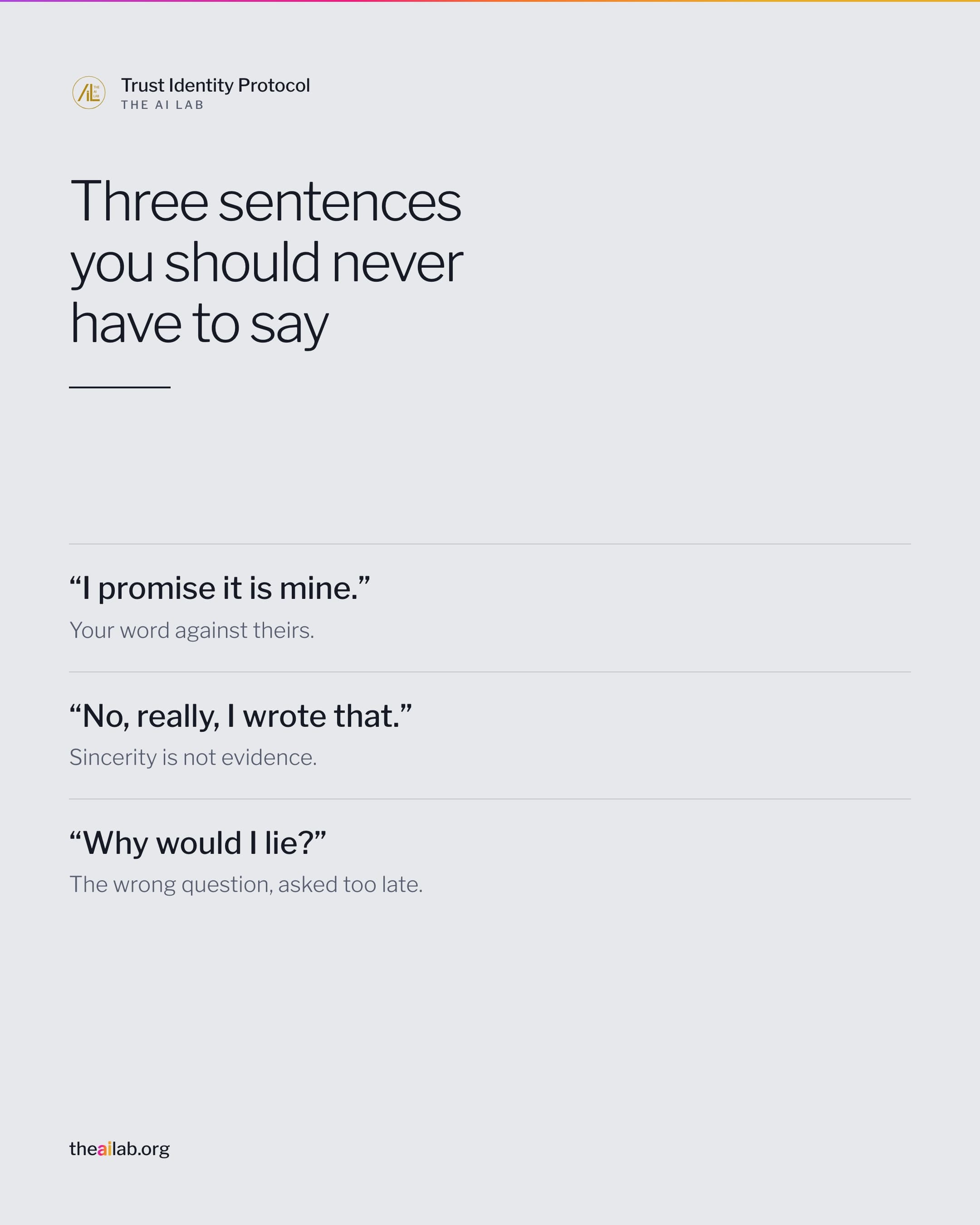
Three sentences you should never have to say
Listen for these. Each one is the sound of a missing record.
“I promise it is mine.” Your word against theirs, and your word is the weaker one, because you are the person with something to gain.
“No, really, I wrote that.” Sincerity is not evidence. The more sincere you sound, the more you are performing rather than proving.
“Why would I lie?” The wrong question, asked too late. By the time you are arguing about motive, you have already lost the argument about fact.
What proof looks like when it is ordinary
Here is the version of this that does not require anyone to become a technologist.
You verify who you are, once. Not for us, and not for any platform, but for yourself: a permanent identity that belongs to you and follows you across every site that recognises it. For individuals, journalists, students, teachers and nonprofits, that is free, and it stays free.
Then, when you publish something, you sign it. One click as you post. Your device asks for your face or your fingerprint, signs the work, and forgets the key again. Nothing of yours is uploaded. What is recorded is a mathematical fingerprint of the work, your signature, the moment, and one honest label saying how the thing was made: entirely by you, by you with AI as a tool, by you and AI in separate parts, or by AI from your instructions.
After that, anyone can check it. No account, no fee, no permission from us.
That is the whole product. Everything else we build exists to make those three steps boring.
Do not take my word for it, which is rather the point
An argument about proof should not ask you to trust the person making it.
So try this. Take something with a TIP record and check it at findtip.org. You will not be asked who you are. Then change the work, even slightly. Crop the photo by a few pixels, alter one sentence, re-encode the audio. Check it again.
The record does not argue with you. It simply no longer matches. That is the difference between a claim and a fact you can test yourself, and it is why we made verification free and account-free from the first day: a proof that only some people can check is not a proof, it is a privilege.
Original is not a style. It is a fact.
Somewhere in the past few years, the word original drifted. It came to mean a look: handmade, imperfect, artisanal. A vibe you could imitate.
But original was never a style. It is a claim about history. It says this came from a particular person at a particular moment, and nothing since has changed it. That is either true or it is not, and until recently we had no ordinary way to settle which.
We do now. That is worth more than any aesthetic, because it is the one thing a generator cannot copy: not the look of the work, but the fact of who made it.
What we do not do
I would rather you hear the limits from us than discover them later.
A record does not stop copying. Anyone can still download, screenshot, crop, re-upload or train on your work. Nothing anyone builds can prevent that, and a company that tells you otherwise is selling comfort. What changes is that they cannot take the authorship with them.
A record is not copyright registration. It is not a filing with any government office and it does not decide ownership in law. It evidences that a verified person made a specific statement about a specific work at a specific time. In most disagreements, that is precisely what was missing.
We do not fight on your behalf. We do not crawl the internet looking for your work, and we do not send letters. We give you the evidence and leave the decisions to you.
And declaring AI involvement costs you nothing. There is no penalty for honesty in either direction. The only thing that damages your standing is claiming a human made something that a machine did.
The record you will want to keep
There is a second life to these records that has little to do with disputes.
Each signed work gets its own small page: your name, the date, the moment, the label. It is a link you can put in a biography, attach to a portfolio, or send to your parents. Nothing about it feels like an audit trail.
I suspect that will turn out to be the underrated half of the idea. We set out to build an evidence system, and what it also produces is a record of a working life: the year the album finally shipped, the night the story broke, the quiet afternoon the photograph happened.
Proof is the reason you sign. The record of a life spent making things is the reason you keep signing.
Who goes first
Every standard that ever mattered began with a small group who adopted it before it was convenient. The padlock in your browser was once a curiosity that serious sites bothered with, and then one day every site without one looked negligent.
This will follow the same path, and the people who start now will not simply be early. They will be the ones whose back catalogue is already on the record when the rest of the internet catches up.
If you make things, you already know whether your work is yours. The only new part is that now you can show it.
Anyone can say it. You can prove it.
Start at vp.theailab.org, or read how the Trust Identity Protocol works. The specification is public and free to implement.
Sofia Martinez is the Chief Executive Officer of The AI Lab Intelligence Unobscured, Inc. She leads the standards, ethical frameworks and product execution behind the Trust Identity Protocol (TIP), the open standard for verified human identity and content provenance on the internet.