
Explainer
Is This Real? The Trust Identity Protocol, Explained Simply
A simple standard that lets creators prove their work is theirs and lets everyone else verify it in one tap.
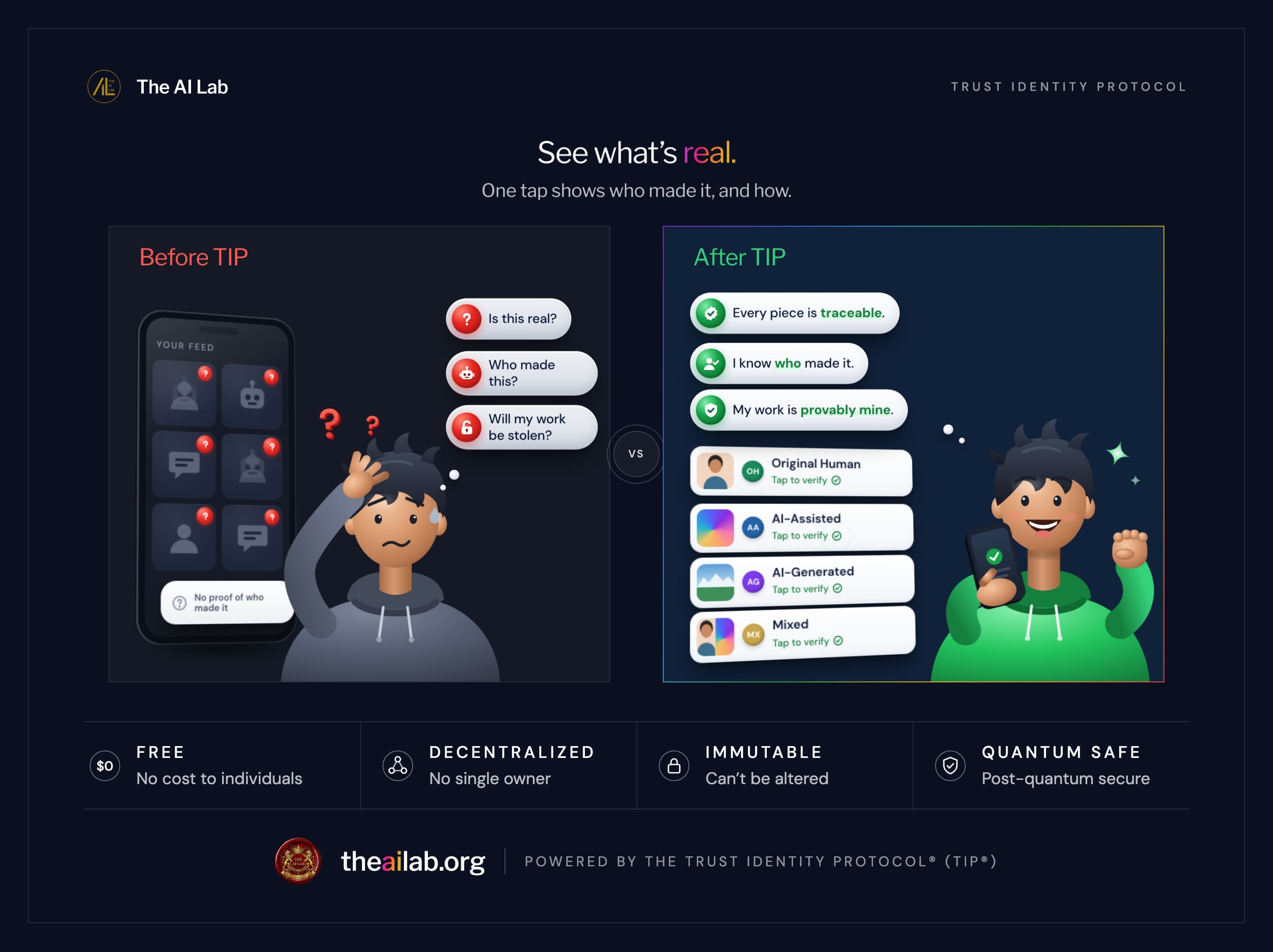
Before TIP and after TIP. Illustration concept by Harsh Pachori.
Every day online we quietly ask the same three questions:
- Is this real?
- Who made this?
- Will my work be stolen?
For a long time, we answered them with instinct, looking at the account name, the writing style, the logo. Generative AI has broken that instinct. A cloned voice can sound right. A synthetic photo can look right. A convincing article can read right.
We do not need better guessing. We need a way to know.
The Trust Identity Protocol (TIP) is a free, open standard from The AI Lab that gives a straightforward answer. A verified person can permanently sign what they publish and label it as one of four clear categories:
- Original Human (OH): made entirely by a person, with no AI generation
- AI-Assisted (AA): the person is the main author, and AI helped edit, suggest, or enhance
- AI-Generated (AG): AI did main generation, & the person prompted, selected, or curated
- Mixed (MX): human and AI work combined from more than one source
Anyone can then check who made the content and how it was made, in one tap, without an account. That is the whole idea.
Before TIP and After TIP
Nothing about how you browse has to change. The difference is that the answer is now attached to the content itself.
How It Works in Three Steps
- Get verified once. A creator obtains a free TIP-ID from an accredited Verification Provider. It takes a few minutes. Your raw biometric data is never stored. One person, one TIP-ID, usable across platforms.
- Sign as you publish. Content is signed through the TIP browser extension (Chrome, Firefox, Safari), a WordPress plugin, or the API. Each piece receives a permanent Content Trust ID (CTID) and one of the four labels above.
- Anyone can verify. A reader taps the TIP badge or opens the CTID link which travels with the content. They see who made it, the label, and whether anything has changed since. No account. No cost. Works on any platform.
Why TIP Matters to You
If you read, watch, or share things online, you get a clearer answer to “is this real?” before you believe it, forward it, or act on it. That matters most for the people in our lives who are most likely to be targeted: older parents, teenagers, anyone who is busy and trusting.
If you create things, photographs, music, writing, design, video, you get proof that your work is yours. When a copy turns up somewhere with your name stripped off, you do not have to argue. You point to a dated, signed record that existed before the copy did, and anyone can check it in seconds.
If you run a small business, you can show customers that your content, reviews and announcements genuinely came from you, and label anything AI-assisted honestly instead of hoping nobody asks.
If you are a journalist or publisher, your byline becomes something a reader can verify, not just trust.
What Makes TIP Trustworthy
A system that tells you what to trust has to be trustworthy itself.
- Free: signing is free for individuals, and verifying content is free for everyone, forever.
- Decentralized: Maintained by independent nodes with no single entity in control.
- Immutable: records are append-only. A record cannot be quietly edited or erased.
- Open: Published under CC BY 4.0 for anyone to use and build on.
- Quantum-safe: Uses post-quantum standards designed to withstand future quantum attacks.
It is governed by the independent AI Trust Council®, not by any single company.
The Rules Are Catching Up
Governments and standards bodies are increasingly asking for the same things TIP already provides, clear labels on AI-generated content and records that can be checked.
The EU AI Act (Article 50) will require AI-generated content to be marked in a machine-readable way from August 2026. Similar expectations appear in frameworks from NIST, ISO, Australia, and Singapore. TIP does not replace these rules. It simply gives people and organizations a practical way to meet them with evidence anyone can verify.
What TIP Does Not Do
TIP does not stop someone from copying your work, and it does not stop an AI model from training on it. What it does is prove who made something and how, even after it has been copied.
It is evidence, not a lock.
A label is a declaration by the creator. TIP makes that declaration signed, public and accountable, with a dispute process when someone gets it wrong.
How to Start Today
- Read and verify: install the TIP browser extension, or simply open any CTID link you come across.
- Protect your own work: get a free TIP-ID at vp.theailab.org and sign what you publish.
- Learn more: the full protocol overview and whitepaper are free to read on theailab.org.
Frequently Asked Questions
What is the Trust Identity Protocol?
An open, free standard that verifies the person behind content and labels it as Original Human, AI-Assisted, AI-Generated or Mixed, so anyone can check who made it and how.
Is TIP free?
Yes for individuals. Verifying content is free for everyone. Larger businesses use a published commercial license.
Do I need an app to check content?
No. The CTID link works on any platform. The browser extension simply shows the badge inline.
Is my biometric data stored?
No. Verification happens once through an accredited provider, and raw biometric data is never stored.
Who runs TIP?
TIP is published by The AI Lab Intelligence Unobscured, Inc. and governed by the independent AI Trust Council, with five constituencies holding equal votes.
I have spent my career in an industry built on one idea: that you can trust who you are dealing with. The internet is losing that idea fast. When I first saw the Trust Identity Protocol, I realized it was not really a technology story. It is a trust story, and it belongs to everyone.
That is why the Before and After picture matters. If ordinary people can understand it in under a minute, it can change how all of us decide what is real.
Harsh Pachori is Vice President of Product Management at JPMorgan Chase & Co. He conceived the Before TIP and After TIP illustration to explain the Trust Identity Protocol to everyday internet users. He writes here in a personal capacity; the views are his own and are not those of his employer.
Also published on Medium: Is This Real? The Trust Identity Protocol, Explained Simply