
Guest Essay
Why the Trust Identity Protocol Serves Both Legal and Humanitarian Respect for Data Integrity
A power of attorney contested in a filing and a directive nobody can confirm at the bedside are not two problems. They are one missing record, failing the same person twice.
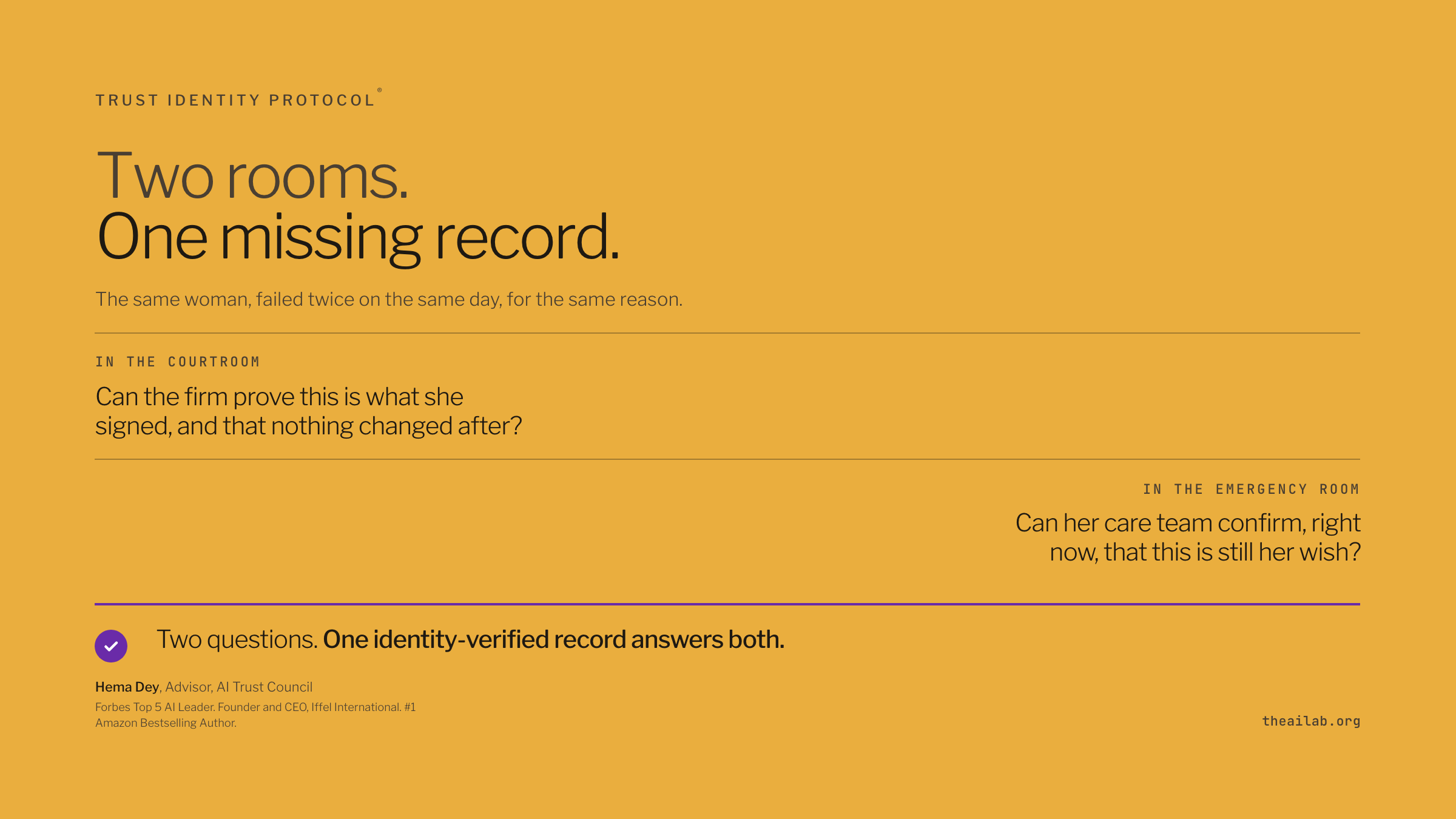
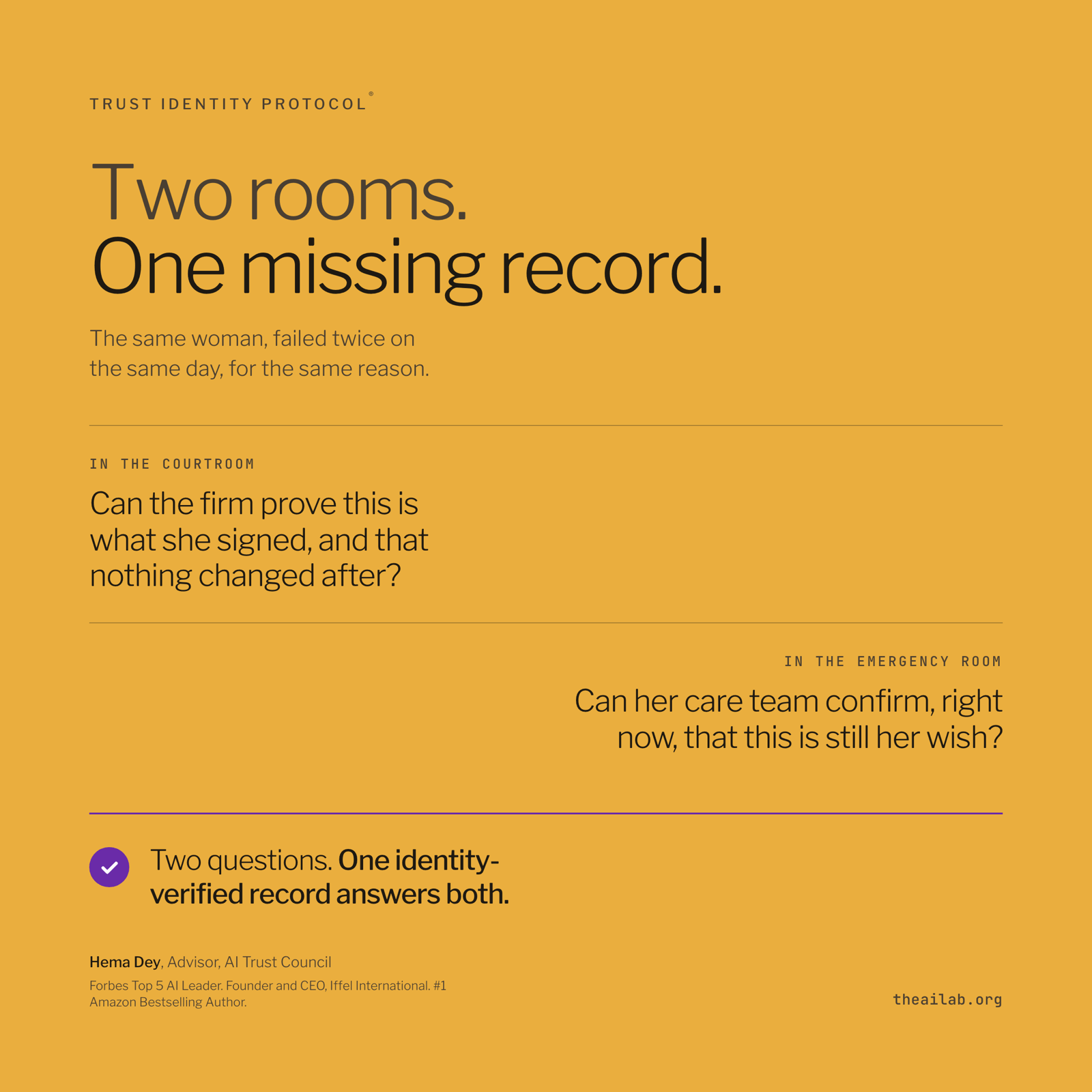
Two rooms, one missing record. The same woman, failed twice on the same day, for the same reason.
Consider a case that any elder law practice will recognize. An elderly woman is moved between hospice care and her daughter’s home twice in one year. Her power of attorney was updated eighteen months ago, after a falling out with one son, to remove him from financial decisions. That same son now claims, in a filing, that the update was the product of undue influence and should not control.
At the same time, in a different room entirely, her healthcare directive sits unverifiable. It is a clear and considered refusal of aggressive intervention. Nobody can confirm on the spot which version is current.
Two failures, happening to the same person, at the same time, from the same root cause. One is a legal problem: can the firm prove the power of attorney update was genuine, properly executed, and not altered or coerced. The other is a human one: can her actual wishes be honored, right now, by people who never met her and have no way to confirm what she truly asked for.
Both failures come from the identical gap. Nobody can point to an unalterable, verifiable record of what this specific person actually said, when, and that nothing changed it since.
This is why legal respect and humanitarian respect for a client’s information are not two separate problems requiring two separate solutions. They are two consequences of the same missing infrastructure, and it is exactly what the Trust Identity Protocol is built to close.
Legal respect: can this be proven
The legal dimension of data integrity is the one firms are trained to think about. Can the firm show that a document reflects what the client actually intended. Can it show who touched it, when, and that nothing was altered after execution.
This is what protects a power of attorney against an undue influence claim, what protects a will against a contest, and what protects a firm against a malpractice claim when a client or an heir later challenges what happened.
Courts and bar associations are increasingly comfortable asking this question directly, and California’s SB 574 has pushed firms toward treating the answer as documentation they must be able to produce, not a policy they can simply assert. A firm that can point to an identity-verified, immutable record of exactly what was executed and when is answering that question with evidence. A firm that cannot is asking to be believed.
Humanitarian respect: is this person actually being heard
The second dimension gets far less attention in legal practice, but it is no less real. A person’s advance directive, their power of attorney, their sworn account of what happened to them, is not just a legal instrument. It is their voice, captured at a moment when they trusted it would still be their voice later, when they might not be able to speak for themselves.
Honoring that voice is not automatically served by the document existing correctly in a file. It requires the document to be reachable and verifiable by the people who need it exactly when they need it, whether that is an ER physician confirming a DNR in real time or a caregiver confirming which family member actually holds authority to make a decision.
A record that is legally sound but practically unreachable in the moment fails the person just as completely as a record that was quietly altered. Either way, what gets acted on is not actually their voice.
Why TIP serves both without trading one against the other
These two forms of respect are often treated as if they pull against each other, careful legal process on one side, urgent human compassion on the other. Firms and institutions default to caution, because verifying authenticity takes time they do not have in the moment that matters.
TIP is built around closing that tradeoff rather than managing it. By establishing verified identity at each touchpoint where a document or instruction is created or changed, and recording that as an immutable entry rather than an editable file, it produces a single record that serves both questions at once.
The same unalterable, identity-verified entry that lets a firm defend a power of attorney against a later challenge is the one that lets a hospital confirm a directive is genuine and current in real time. Legal defensibility and human dignity turn out to depend on the exact same underlying property: a provable, unaltered original, verifiable by the right party at the right moment.
One plain statement about scope, because it matters for anyone evaluating this seriously. What TIP does today is establish a verified human identity, sign what that person creates or executes, and let anyone check that the record has not changed since. It is not a clinical records system and it does not integrate with hospital software today. The argument here is about the layer those systems would sit on, which is where both failures start.
That is a meaningfully different posture than treating privacy and integrity as compliance obligations layered on top of client care. It treats them as infrastructure for respecting a person twice over, once as a client whose legal intentions deserve to be provably honored, and once as a human being whose voice deserves to be heard exactly when they can no longer speak it themselves.
The objection worth taking seriously
The strongest argument against this is that people change their minds. An immutable record sounds like the opposite of that, and a woman who revises her directive twice in a year is the case that tests it.
Immutability applies to entries, not to intentions. A later signed instruction supersedes an earlier one, and the record’s job is to make unmistakably clear which one is current. That is a design requirement rather than a footnote, and any system that gets it wrong will fail the person it was built to protect.
The second objection is harder. The people whose voices most need protecting are often least able to operate identity verification themselves. Any honest answer involves proxies, guardians and clinicians acting under verified authority, which is precisely why the question of who holds authority has to be provable too.
What this asks of firms
In The Reimagined Law Firm, the case was made that AI governance belongs to firm leadership, because nobody else in the ecosystem, not a vendor, not a fractional executive, is positioned to hold both the legal and the human stakes of a client’s information at once. This is precisely where that responsibility lives.
A firm that treats data integrity purely as a malpractice shield is protecting itself. A firm that recognizes integrity as also protecting a client’s dignity and autonomy is protecting the person the firm was actually hired to serve.
The firms that get this right will not be the ones with the most defensible paper trail. They will be the ones whose paper trail and their client’s actual humanity point in the exact same direction, because the infrastructure underneath was built to serve both from the start.
Hema Dey is a Forbes Top 5 AI Leader, Founder and Chief Executive Officer of Iffel International Inc., and the #1 Amazon bestselling author of The AI Translator. She serves as an Advisor to the AI Trust Council of The AI Lab. Understand your law firm’s malpractice risks at iffelinternational.com.
Read how the Trust Identity Protocol works, or start at vp.theailab.org.