Save a case note
AllowedThe request matches a mandate limited to edits on case CS-204 before expiry.
Worked example | Synthetic data
Verify the ML-DSA-65 signatures on a case-note update and a refused refund, then run the same check against altered copies.
The request matches a mandate limited to edits on case CS-204 before expiry.
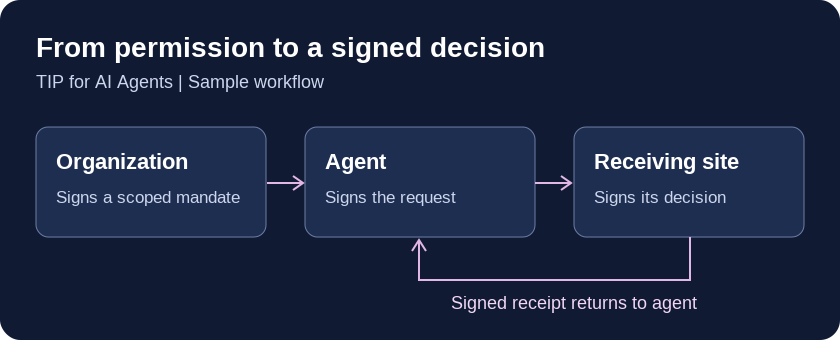
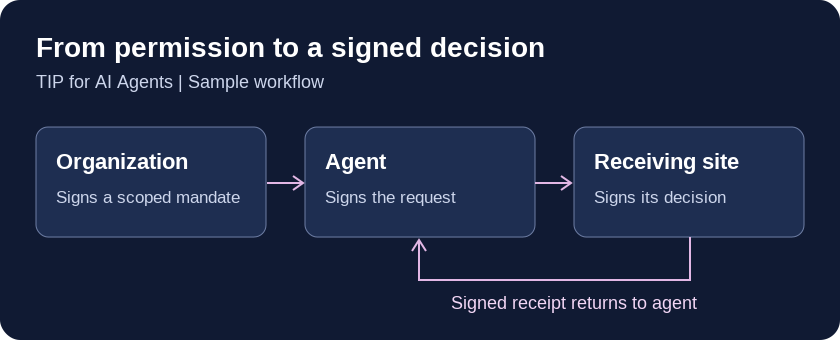
The mandate grants case-note edits. The service desk signs an outside-scope refusal for the refund request.
Save both files in the same folder. Run the command with Node.js and OpenSSL 3.5 or newer with ML-DSA support.
node verify.mjsExpected output:
update_case_note: allowed | signatures match | altered copy rejected
issue_refund: refused | signatures match | altered copy rejected
The verifier checks the issuer’s signature over the mandate, the agent’s signature over each exact request, and the service desk’s signature over each exact receipt. It checks request-to-receipt linkage and the sample permission. Then it changes the decision text while retaining the original signature, and verifies that the altered copy fails.
The signatures use real ML-DSA-65 keys generated for this example. The three keys and fictional requests illustrate the mechanics of site-signed evidence. The sample format is educational. It omits live TIP identity, production request framing, live status, log inclusion, witnessed seals, and ledger anchoring.
In an interim deployment the site retains signed receipts and gives the agent a copy. An interim verifier reports site-signed evidence as held or sealed, with an indeterminate overall result. The full profile adds independent witnessing and ledger anchoring.
Receipt definition | Interim deployment rules | Press and citation resources