
Guest Essay
Signed, Seen and Confident: How the Trust Identity Protocol Can Help Women Step Out of the AI Shadows
Women who use AI at work worry more than men that they will be seen as cheating, and they get less credit for it. Hema Dey argues that an honest, visible label on their work can turn quiet AI use into proof of their judgment.
Disclosure. Hema Dey is an Advisor to The AI Lab's AI Trust Council. She is Founder and CEO of Iffel International, which plans to build the Trust Identity Protocol into its One Brain platform. Dinesh Mendhe, Founder and Chairman of The AI Lab, is Dean of Curriculum and Certification at The AI Translator Academy, which Hema founded.
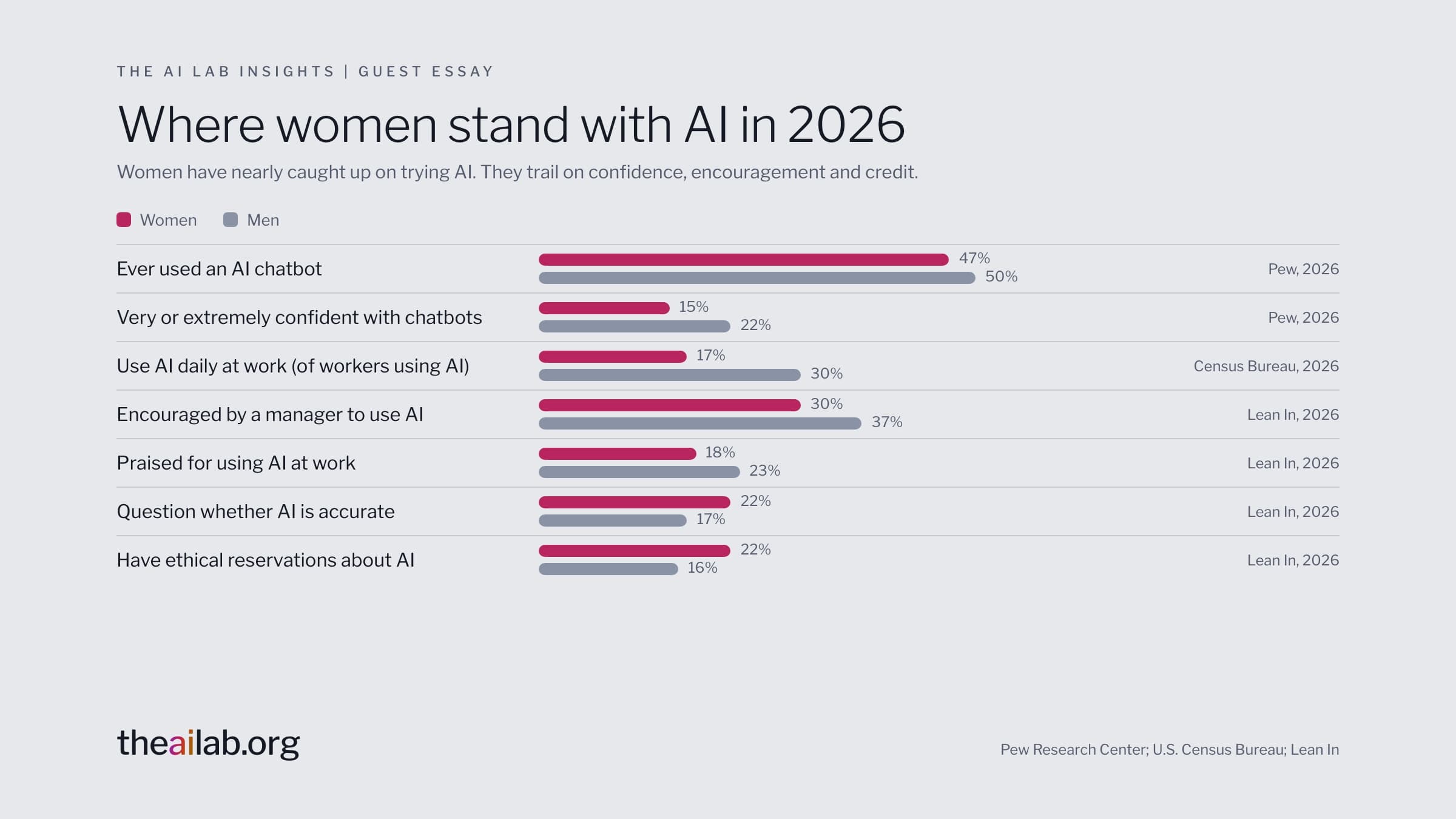
Women who use AI at work are 32% more likely than men to worry that they will be seen as cheating. Lean In's 2026 research found that 29% of women hold that worry, compared with 22% of men, and that only 18% of women who use AI at work have been praised for it, compared with 23% of men.
Women are doing the work of learning a new technology, often without encouragement from their managers, and then worrying about how it will look. When you hide your AI use, you also hide your skill, your judgment and your wins. You miss the credit, and the confidence that comes with it.
As a working mom, business owner and founder of The AI Translator Academy, I teach women AI fluency every week. I have come to believe that women's biggest barrier with AI is trust, more than skill. Women need to trust the tools, trust what is real and trust that using AI openly will be respected. That is why I believe the Trust Identity Protocol could change how women use AI.
Where women stand with AI in 2026
Women have nearly caught up on trying AI, but not on the support to use it with confidence.
At the same time, women make up 83% of workers in the 15 U.S. occupations most vulnerable to AI displacement, according to the National Partnership for Women & Families.
Women are curious, careful and willing. What we lack is encouragement, recognition and a reason to trust that using AI openly is safe.
Why trust is the missing piece
Women's caution with AI is often framed as hesitation. I see it as wisdom. The questions women ask most, “Is this accurate?”, “Is this ethical?” and “Will people think less of me for using it?”, are questions about trust.
There are three kinds of trust at stake:
- Trust in yourself. Will I be credited for my judgment, or accused of cutting corners?
- Trust in what you see. Is this photo, video, message or article real, or was it generated to mislead?
- Trust in others. When a colleague, a school or a stranger online shares something, who actually made it?
Until now, there has been no simple, public way to answer those questions. Training helps women build skill. Confidence also needs infrastructure, a shared, visible standard that says, “This is who made this, and this is how.”
Who's behind it? Ask TIP.
The Trust Identity Protocol (TIP), created by The AI Lab, gives your work a permanent, signed record of who published it and how it was made. The AI Lab built it to help people keep ownership of their work.
Why it matters now
Online, it is getting hard to tell what is real. AI can create convincing videos, photos and text in seconds. Work gets copied, changed and reposted under someone else's name, and the original gets buried. When that happens, the credit, and sometimes the income, goes to the wrong person.
AI content is everywhere now. Real human content is becoming rare, and rare things become more valuable. That includes your ideas, your words and your expertise.
A name tag that can't be secretly changed
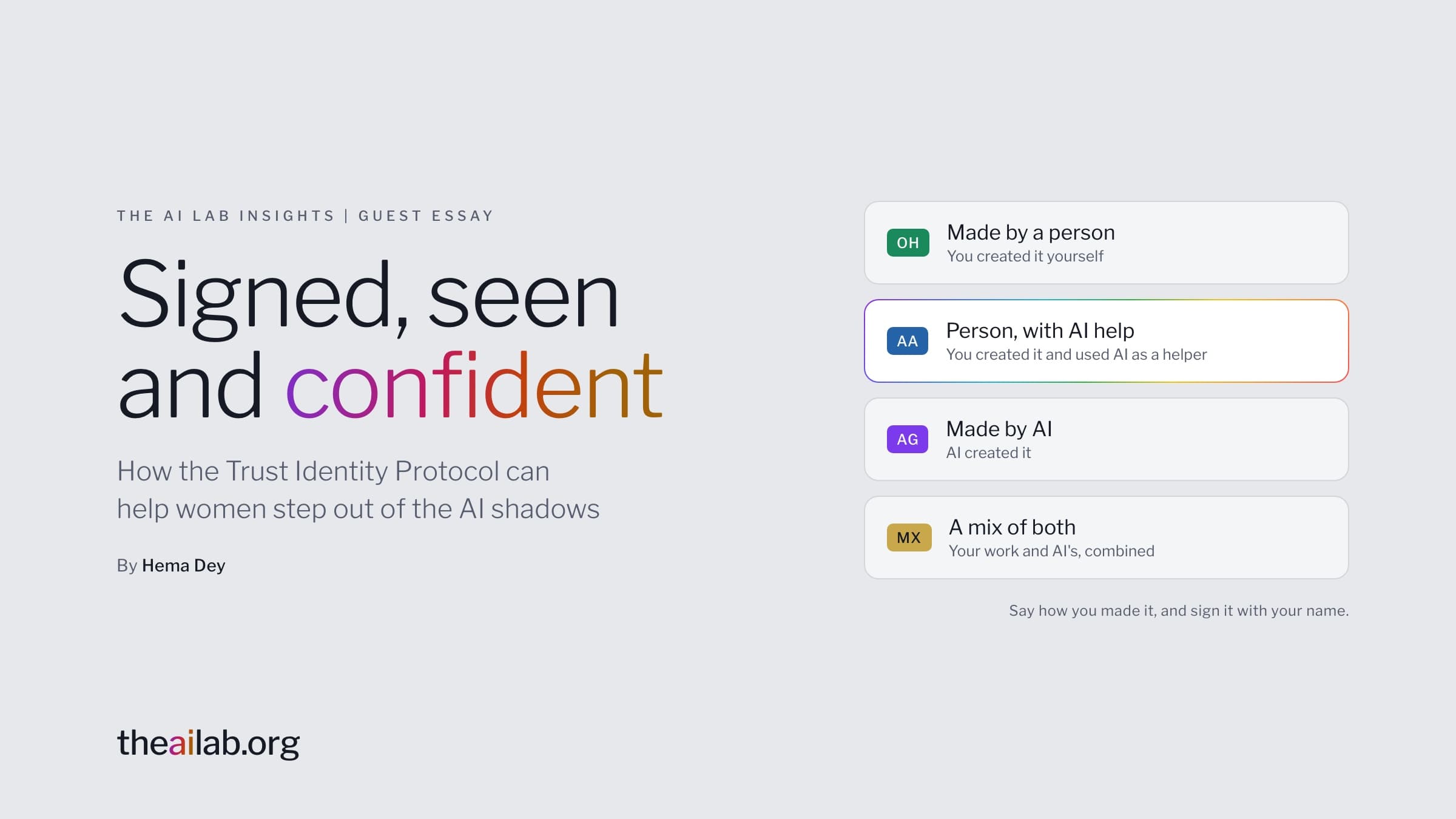
Think of TIP as a permanent name tag for anything you create online. Each piece of content gets one of four simple labels, plus a record of who made it:
| Label | What it means |
|---|---|
| Made by a person | You created it yourself. |
| Person, with AI help | You created it and used AI as a helper. |
| Made by AI | AI created it. |
| A mix of both | It combines your work and AI's. |
If anyone changes the content later, it shows. The record cannot be quietly rewritten.
How it works: make it, tip it, anyone can check
- Make it. Write a post, take a photo, record a video, publish a blog or a book.
- Tip it. With one click from the TIP browser plugin, your work gets your name tag and its label.
- Anyone can check. Readers tap the badge to see who made it and whether it was changed.
You do not need to understand the technology behind it to use it, the same way you do not need to understand how the padlock in your browser works to shop safely online. Behind the scenes, TIP uses digital seals and fingerprints, stored in many places, so no one can quietly fake or alter the record.
What TIP does, and does not, promise
TIP proves where content came from, not whether it is true. A badge means “this really came from this person,” not “this person is right.” You still bring the judgment. TIP tells you whose judgment you are looking at.
How TIP can build women's confidence with AI
TIP was not designed only for women. But its core idea, making honest AI use visible and verifiable, speaks directly to the barriers the data shows women face.
It turns hiding into credit
A woman who drafts a proposal with AI, checks every fact and adds her expertise can tip that work as “Person, with AI help,” with her own name on it. That label does not say “she cheated.” It says “she used a tool, and she stands behind the result.” Over time, that signed record becomes proof of her judgment. Transparency stops being a risk and becomes a reputation.
There is a fair objection. If women are already judged more harshly for using AI, a public label could give critics something to point at. TIP does not remove that bias, and it does not force anyone to label their work. What it changes is who holds the record. Today, AI use is a suspicion others can raise against you. With TIP, it is a statement you make yourself, under your own name, alongside the checking and judgment you added.
It rewards the caution women already bring
Women are more likely than men to question AI's accuracy and raise ethical concerns. A trust standard gives those instincts a place to land. Before trusting a video, an article or a message, women can ask the question at the heart of TIP: who's behind it? Knowing the source does not replace careful thinking, but it gives that thinking a starting point. The skepticism that once looked like hesitation becomes a practical habit of verification.
It aligns with how women want to lead
In my book, The AI Translator, I teach a four-signal framework: Visibility, Validity, Veracity and Values. TIP maps naturally onto it. A verified identity supports Visibility and Validity. An honest human or AI label supports Veracity. And choosing to disclose how your work was made is an expression of Values. Women do not have to choose between using AI and keeping their integrity. With the right standard, the two reinforce each other.
Fluency starts at home
Women are not only professionals. Many of us are also the chief operating officers of our households. We manage calendars, school forms, meal plans, budgets, medical appointments and family logistics, usually in the margins of a full workday.
That makes home one of the best places to build AI confidence, and one of the places where trust matters most.
- Reclaiming household hours. AI can help plan a week of meals, organize a family calendar, compare insurance options or summarize a long school email in seconds.
- Protecting our families. Mothers are often the first line of defense against scams, deepfakes and misleading content aimed at our kids and aging parents. Teaching our families to pause and ask “Who's behind it?” before they share, buy or believe something is becoming a basic family safety skill.
- Raising AI-literate children. When a mom understands AI, she can teach her children to use it wisely, ask questions, check sources and label their own work honestly. Tip it before you post it. That is how the next generation learns fluency from the start.
When women gain confidence at home, it carries into work, and back again. The same judgment that spots a suspicious message in the family group chat is the judgment that spots a flawed AI output in a board report.
Education is the multiplier
A trust standard is only as powerful as the people who understand how to use it. That is where education comes in.
Only 30% of women say a manager has encouraged them to use AI, compared with 37% of men. So at The AI Translator Academy, we extend the invitation ourselves. Classes are taught live, on Saturdays, built around real schedules and real budgets, and grounded in what we call education through kindness. Fear shuts learning down. Kindness opens it up.
When women learn AI fluency alongside tools like TIP, the returns compound:
- Confidence. Women learn to use AI and stand behind their work openly.
- Time. About a third of workers who used AI at work in the past week told the U.S. Census Bureau it saved them one to two hours. Two hours a week is roughly twelve working days a year.
- Credibility. A verified, honest record of how you work becomes part of your professional reputation.
- Leadership. Confident women teach their children, support their friends and guide their communities, spreading fluency far beyond one person.
This is how women go from hiding their AI use to leading with it.
Time to step out of the shadows
The data shows that women have lacked encouragement, recognition and trust. Education addresses the first two. Standards like the Trust Identity Protocol help address the third.
Imagine a world where a woman can say, with pride and proof, “I used AI to do this, here is how I checked it, and here is my name on it.”
When women gain the confidence to learn, use and apply AI openly, we get back the time we so badly need. And we use it to lead our families, our friends and our communities into a future we helped shape.
Hema Dey is the Founder and CEO of Iffel International, author of the #1 Amazon bestseller The AI Translator, founder of The AI Translator Academy, which teaches women AI fluency through live, human-led programs, and an Advisor to The AI Lab's AI Trust Council. A working mom and business owner, she believes AI is the great equalizer for women. Read her white paper, Helping Women RISE with AI.
Disclosure. Hema Dey advises The AI Lab's AI Trust Council, and Iffel International plans to build the Trust Identity Protocol into its One Brain platform. Dinesh Mendhe, Founder and Chairman of The AI Lab, is Dean of Curriculum and Certification at The AI Translator Academy. Content signed with TIP becomes a Verifiable Asset.