
News
The AI Lab Takes TIP to OC Tech Week and ACG Inland Empire to Prepare Business Leaders for a Shorter Quantum Timeline
The AI Lab will present the Trust Identity Protocol in Irvine on October 20 and in Ontario on October 21, opening an education campaign for business leaders on a quantum timeline it says AI has cut from about 20 years to two.

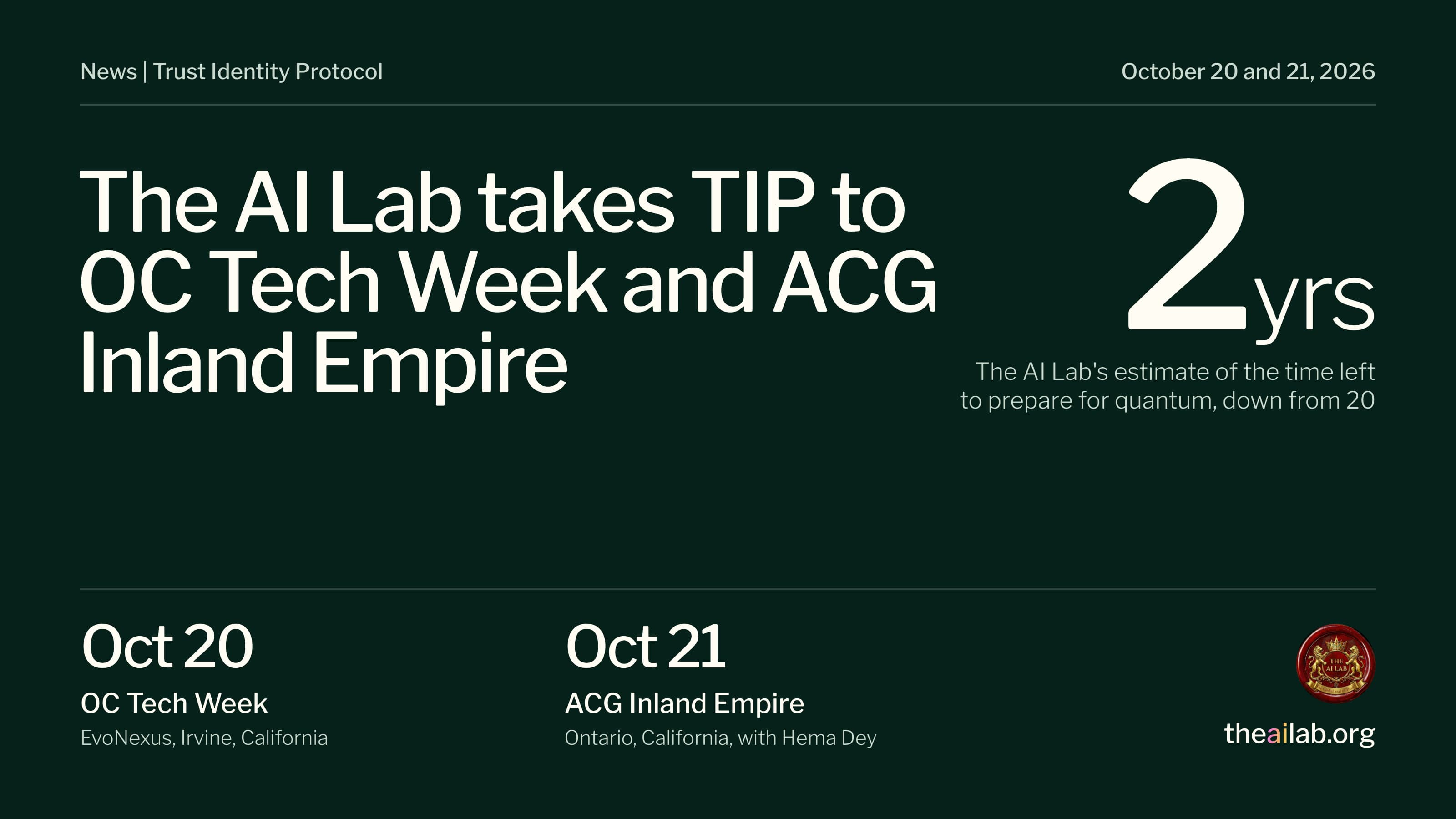
The AI Lab will take the Trust Identity Protocol (TIP) to two Southern California business events this month. The first is OC Tech Week in Irvine on October 20. The second is the Association for Corporate Growth (ACG) Inland Empire chapter in Ontario, California, on October 21, with Hema Dey, Founder and CEO of Iffel International.
The two sessions open a campaign to brief business leaders on how fast the quantum computing timeline is shrinking, and on what forged digital signatures would mean for anyone who has to prove who made a piece of work. The AI Lab announced them on October 8 in a release distributed by EIN Presswire.
Two sessions, two audiences
The OC Tech Week session runs from 12 to 4 pm Pacific time at EvoNexus Irvine, 101 Academy Way, Suite 130, as part of OC Tech Week 2026, which runs October 19 to 24 across Orange County. It is a hands-on session for creators and businesses, and registration is free on Luma. Attendees will watch TIP sign content and check its CTID, and anyone who brings a government-issued photo ID can get a TIP-ID on the spot.
The ACG Inland Empire session is a workshop for middle-market executives, Before They Call You They Asked ChatGPT, The AI Brand Trust and GTM Workshop for Business Leaders. It runs from 4 to 6:30 pm Pacific time at AmPac Business Capital, 3110B Inland Empire Boulevard, Ontario. Dey facilitates it and will also share updates to her AI search playbook, covering search engine optimization for AI, answer engine optimization and generative engine optimization. She is an Advisor to the AI Trust Council, which governs TIP.
“Business leaders do not need to become quantum physicists. They need a plain-language understanding of the timeline, the risk to their company's ideas and content, and the first steps to take. That is what this campaign is designed to deliver.”Hema Dey, Founder and CEO, Iffel International
Why the timeline sets the date
The AI Lab says AI has cut the time the world has to prepare for quantum computing from about 20 years to about two. That is the company's own estimate, and the research behind it has moved fast. In 2019, Craig Gidney and Martin Ekerå estimated that breaking RSA-2048, the encryption behind much of today's digital trust, would take about 20 million noisy qubits. Gidney, of Google Quantum AI, cut that to fewer than one million in May 2025. In February 2026, the Pinnacle Architecture paper put it below 100,000 physical qubits, under stated engineering assumptions.
In March 2026, Google set 2029 as its own deadline to move to post-quantum cryptography and named digital signatures a priority.
“Most business leaders still think of quantum computing as a distant research topic. With AI accelerating quantum research, I believe we have roughly two years to prepare. These sessions are about giving people the facts early enough to act on them.”Dinesh Mendhe, Founder and Chairman, The AI Lab
Not every expert puts the date that close. In the Global Risk Institute's Quantum Threat Timeline Report 2025, surveyed experts gave a 28 to 49 percent chance that a computer able to break today's cryptography arrives within ten years. NIST's draft transition guidance proposes deprecating RSA-2048 after 2030 and disallowing it after 2035. The AI Lab's case is that proof of authorship has to be in place before that point arrives, whichever year it is.
What a forged signature would put at risk
Digital signatures are how the internet proves who wrote, made or approved something. A quantum computer able to break today's signatures could be used to forge a record of who created an article, a song, a design or an idea, or to cast doubt on a real one. The sessions walk through five fields.
- Journalism
- A story carrying a CTID shows which reporter or newsroom published it and whether anyone has changed it since, so other outlets can check and cite the original instead of a copy.
- Publishing
- Authors and publishers can trace each edition, excerpt and translation back to its source, which can support royalty and licensing income when copies circulate.
- Film and trailers
- Studios, producers and trailer houses can put a CTID on official trailers and cuts, so audiences can find the authentic release. The record also carries the studio's declaration of whether performances are human, AI-assisted or AI-generated.
- Technology
- Developers and research teams can record who wrote code or created a design, and when, before sharing it with partners, customers or investors.
- Patents and trademarks
- A dated, signed record of when an idea, design or mark was created can be offered as supporting evidence in a dispute over who came first. It does not replace a patent, trademark or copyright filing, and how a court weighs it depends on the jurisdiction and the case.
What TIP records
TIP gives a piece of digital content a CTID (Content TIP ID), a signed public record linked to the verified person who made it. The record holds who made it, the creator's own declaration of whether a person, AI or both made it, and a fingerprint that shows whether it has changed. Signatures use ML-DSA-65 from NIST's post-quantum standard FIPS 204, and each record is written to an immutable, decentralized ledger, so it cannot be edited or erased once written. Content that carries a CTID is a Verifiable Asset.
TIP proves where content came from and whether it changed. It does not prove the content is true, and the origin label is the creator's declaration, which anyone can dispute.
“Every idea, every article, every film is a piece of someone's life. We accelerated TIP because people should not have to wonder whether proof of their work will hold up in the quantum era.”Dr. Sofia Martinez, Chief Executive Officer and President, The AI Lab
How to get it
TIP is available now through a browser extension and a web app. It is free for individuals, nonprofits, schools, government agencies, newsrooms for editorial use and businesses under $100,000 in annual revenue. Larger companies need a commercial license. Anyone can set up a TIP-ID at vp.theailab.org, and the full specification is in the TIP Whitepaper.
Where the release ran
EIN Presswire distributed the release on October 8, 2026. These outlets carry it in their press release sections, and the distribution report lists many more local news and network sites.
- National Law Review
- WGN 9, Chicago
- KRON 4, San Francisco
- KXAN, Austin
- The Arizona Republic, Phoenix
- The Detroit News
- The Des Moines Register
- The Courier-Journal, Louisville
- The Desert Sun, Palm Springs
- The Record, North Jersey
- CES News Today, EIN News
- CPAC News Today, EIN News
The AI Lab publishes this article and runs both sessions it describes. The press release it reports is an Original Human Verifiable Asset signed by The AI Lab. Verify the release (tip://c/OH-c50c7f65d5a746-a21d).
Dinesh Mendhe is the Founder and Chairman of The AI Lab and the inventor of the Trust Identity Protocol. The AI Lab is led by Chief Executive Officer Dr. Sofia Martinez. Follow The AI Lab on LinkedIn, YouTube, X and Instagram.